

A portable padel court is a full 20×10 m padel court built on a self-supporting, self-weighted steel base instead of a concrete foundation — so it can be assembled in about 48 hours on any flat surface, dismantled in 24, and moved without a single bolt in the ground.
Picture this: a padel court in the middle of a historic city square. Not a permanent install that takes six months of permits and a poured slab — a court that shows up on a truck, goes up on Friday, hosts a weekend tournament, and vanishes by Monday morning, leaving the square exactly as it was. In 2026 that’s not a concept; it’s a product line, and it’s why events, brands, and market-testing operators keep calling.
But “portable” hides a real trade-off, and buying one without understanding it is how operators end up with a court that wobbles in the wind or costs more than a permanent one. This guide covers how portable courts actually work, when they beat permanent builds, what they cost, and the engineering that makes a court both movable and solid. We build padel courts — portable and permanent — at our factory in Hengshui, China, so the setup and transport details below come from the loading dock.
Key Takeaways
– A portable court needs no foundation: a self-weighted steel base holds it down, so it installs on asphalt, car parks, rooftops, or historic squares without drilling — often bypassing permanent-structure permits.
– Setup runs about 48 hours, teardown about 24, and a well-built court is engineered for 50+ assembly cycles, which is what gives it resale and rental value as a mobile asset.
– Portable isn’t always cheaper: a modular court typically runs €22,000–€35,000 (or ~$6,000–$12,000 factory-direct for the kit), but you skip the €5,000–€9,000 foundation — the saving is in what you don’t build, not the court itself.
– The trade-off is stability and permanence: portable courts play almost identically to permanent ones on calm days, but they’re rated for lower wind loads and repeated handling wears components faster.
– Choose portable for events, pop-ups, seasonal sites, and market testing; choose permanent for a club that will live in one place for years.
What Is a Portable Padel Court?
A portable padel court is a regulation-sized court (20 × 10 m, same FIP playing dimensions) whose structure is designed to stand on its own without being anchored to the ground. Instead of a concrete foundation with drilled expansion bolts, it uses a self-weighted base — heavy steel perimeter modules that hold the court down through their own mass, plus modular bolt-on connectors that let the whole thing come apart and go back together.
You’ll also see these sold as temporary padel courts or mobile padel courts. In practice all three names describe the same product family: a court you can install, take down and move. The difference is emphasis. Temporary usually means a short-term activation — a tournament, a season, a pop-up venue — measured in weeks or months. Mobile implies a court that moves repeatedly between sites as a matter of routine. Portable is the umbrella term that covers both. The test is simple: if a supplier’s structure needs a concrete slab, it is none of the three.
The result is a court that’s structurally complete but location-agnostic. It doesn’t need a slab, doesn’t damage the surface beneath it, and can be packed into standard shipping containers and trucked to the next site.
What it shares with a permanent court: the 20×10 m playing area, the tempered glass back walls, the mesh side fencing, the artificial turf, and the lighting. What it trades away: the total rigidity and weather rating of a bolted-down structure. A portable court is engineered to be moved, which means its stability comes from clever weighting rather than a fixed anchor — and that’s a difference you notice in high wind.
Portable vs Permanent Court
If you’re choosing between a portable court and a permanent build, here’s the comparison that matters — and it’s not “which is better,” it’s “which fits your situation.”
| Factor | Portable Court | Permanent Court |
|---|---|---|
| Foundation | None — self-weighted base | Concrete slab + drilled anchors |
| Ground damage | Zero | Permanent |
| Assembly | ~48 hours up, ~24 down | Weeks (foundation cures, glass installs) |
| Permits | Often bypassed (non-permanent) | Full building/planning process |
| Wind rating | Lower — sheltered sites preferred | High — engineered to local wind load |
| Lifespan | 50+ assembly cycles, lighter duty | Decades with maintenance |
| Resale | Strong — mobile asset, rentable | Tied to the land |
| Cost | Kit ~$6,000–$12,000; modular €22k–€35k | €18k–€60k installed (Europe), more in US |
| Best for | Events, pop-ups, seasonal, market tests | Clubs, resorts, long-term venues |
The honest summary: portable courts win on speed, flexibility, and exit strategy; permanent courts win on durability, wind resistance, and long-term cost. A portable court you set up and leave in one place for five years is the worst of both worlds — you paid for mobility you’re not using, and you accepted a lower wind rating you didn’t need to.
If you’re comparing court types more broadly, our portable vs permanent — or for the full picture, see how a panoramic court fits into the mix — covers the decision matrix in depth.
Want to see the portable court in action? Browse our Portable Court specifications →
Foundation & Assembly: How Portable Courts Stand Up
The magic of a portable court is that it stands up without being tied down — and understanding how that works is the key to speccing one that doesn’t disappoint.
The Self-Weighted Base
Instead of bolts into concrete, a portable court uses a heavy steel perimeter weighting system. The base modules are filled or built heavy enough that the court’s own mass — distributed around the full perimeter — resists the forces of play and moderate wind. Think of it like a heavy bookshelf you don’t need to screw into the wall: it stays put because it’s heavy and low, not because it’s attached.
This is why portable courts can go where permanent ones can’t: a rented venue, a protected historic square, a rooftop, a shopping-mall atrium. No holes, no damage, no cleanup — remove the court and the surface is untouched.
Assembly: 48 Hours Up, 24 Hours Down
Modular design is the whole game. The steel frame, glass panels, mesh, and turf all break into components that lock together with bolt-on or click-lock connectors. A professional crew can have a court fully playable in about 48 hours and dismantled in about 24. For a weekend event, that’s set up on Friday, play on Saturday, gone by Monday.
This speed isn’t just convenience — it’s the business model. A court that goes up and down in days can chase the calendar: summer at a beach resort, autumn at a city festival, winter in a mall atrium.
Transport: Engineered to Fit in Containers
A portable court’s second hidden engineering feat is that it packs. The components are sized to fit into standard shipping containers — typically two 40HQ containers for a full court — with the glass racked and padded so it survives the trip. This is the same discipline that matters for permanent courts, but it’s more important for portable ones, because they make that trip repeatedly. A court designed for 50 cycles needs 50 safe packings, not one.
How We Design Modular Self-Supporting Courts at Our Hengshui Factory
Portable courts look simple from the outside and are unforgiving to build badly. Here’s the manufacturer’s view of what separates a court that tours for a decade from one that wobbles after two events.
We design the weighting system as engineering, not as “add sandbags.” The stability of a self-supporting court comes from mass placed exactly where play and wind push hardest — around the perimeter and at the corners, where the glass takes lateral load. We calculate the required ballast per panel so the court holds rigid under match play, not just sits there. A court that merely “looks” self-supporting but skimps on base mass will flex visibly during a hard rally — players feel it, and so do the glass panels.
We build the connections for 50+ cycles. The failure point of any portable court is the joint: a connector that’s tight on assembly one and sloppy by assembly twenty. We use bolt-on modular connectors machined to a consistent tolerance, and we galvanize everything — including the mobile base — so repeated outdoor setups don’t rust the parts that get handled most. A portable court lives a harder life than a permanent one, because it’s constantly being taken apart; the materials have to be over-built for that abuse.
We pack for the trip, not just the product. This is the part buyers never see until a glass panel arrives cracked. Portable courts ship repeatedly, so we rack the tempered glass upright in A-frame steel cradles with rubber separation and plywood crating, and we trial-assemble every court before it leaves the factory. A court that arrives pre-fitted ships flat and assembles square; a court that ships as a pile of parts becomes an on-site puzzle with a cracked corner.
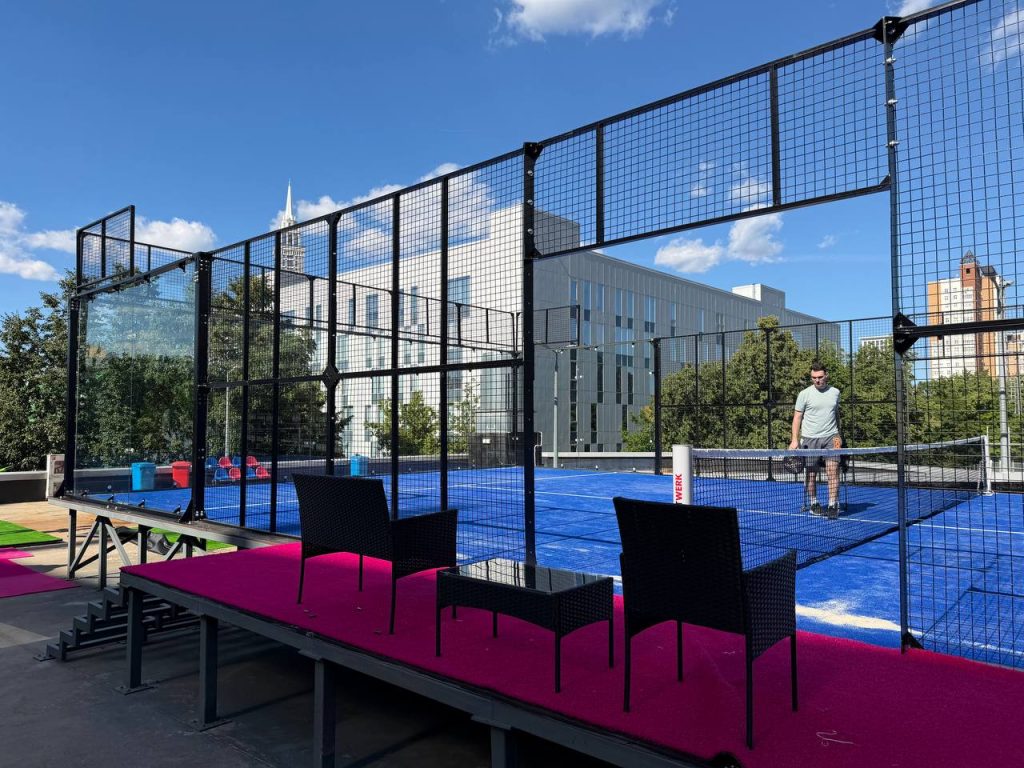
We’re honest that “portable” has a weather limit. A self-supporting court is not a permanent court. It’s rated for lower wind loads, and an exposed coastal or hilltop site that’s fine for a bolted-down build is wrong for a portable one. We tell buyers this up front, because a portable court blown sideways on its third event is a problem no warranty fixes.
Youssef runs a sports-marketing agency in Dubai. In 2025 he bought a portable court to run brand activations across Gulf shopping malls and beach festivals — same court, six different cities in a year. What sold him wasn’t the court’s looks; it was that it packed into two containers and his crew could set it up in a weekend without a foundation. “Every city we touched had different rules about what we could build,” he told us. “A permanent court would have been six months of permits. This was a phone call and a flat surface.”
If you’re planning events or seasonal play, the first question is whether your sites are flat and sheltered. Talk to our engineers about your locations →
Best Use Cases for a Portable Court
Portable courts aren’t a cheaper permanent court — they’re a different tool for a different job. Here’s where they genuinely shine.
- Events and brand activations. A padel court in a festival, a product launch, or a city square is a crowd magnet. Portable courts turn the sport into a marketing asset you can deploy anywhere.
- Pop-ups and seasonal sites. A beach resort that only needs courts for summer, a ski town that wants them in winter, a fair that runs for six weeks — all cases where a permanent build is dead capital the rest of the year.
- Market testing. Not sure padel will take off in your city? A portable court lets you test demand for a season before committing to a permanent facility. It’s the cheapest market research in the industry.
- Rooftops and protected spaces. Where drilling is forbidden or the structure can’t take a slab — historic buildings, rooftops, mall atriums — the self-weighted base is the only option.
The common thread: a portable court earns its keep when the location is temporary. If the location is permanent, buy a permanent court and spend the difference on better glass and a stronger frame.
Cost, Rental & ROI
What does a portable court actually cost — and how do you make the money back?
Purchase Cost
Factory-direct, a portable court kit typically runs $6,000–$12,000, while a modular or mobile system with professional-grade glass and turf lands around €22,000–€35,000. That spread reflects the same variables as any court: glass thickness, frame gauge, turf quality, and lighting.
The key economic insight is what you don’t pay. A permanent court carries a €5,000–€9,000 foundation (more on difficult ground), plus drainage and site prep. A portable court skips all of that — which is why, even when the kit price is similar, the installed total is often lower and the timeline is measured in days instead of months.
Rental Economics
Portable courts have an option permanent courts don’t: you can rent instead of buy. Many operators rent a fully-assembled court for a single event — transport, setup, play, and removal all handled — which turns a five-figure asset into a single line item on an event budget. And if you own one, that same court is a rental revenue stream: it can be out earning at someone else’s event when you’re not using it.
ROI Logic
The return on a portable court comes from utilization, not ownership. A court that chases demand — summer here, winter there, a festival in between — can log more playing weeks a year than a permanent court that sits idle in the off-season. Add the resale value (a court engineered for 50+ cycles holds its worth as a reusable asset), and the exit strategy is built in.
The caution, again, is matching the court to the site. A portable court on a windy, exposed location loses days to weather and risks damage; a portable court moved every few weeks and stored properly pays for itself fast.
Get a spec-based quote for a portable court that fits your event calendar →
What is a portable padel court?
A portable padel court is a regulation 20×10 m court built on a self-weighted steel base instead of a concrete foundation. It installs on any flat surface without drilling, assembles in about 48 hours, and can be dismantled and moved — making it ideal for events, pop-ups, and seasonal sites.
Does a portable court really need no foundation?
Correct. A portable court uses a self-supporting weighted base that holds the structure down through its own mass, so there’s no concrete slab and no drilled anchors. This lets it install on asphalt, car parks, rooftops, and protected spaces — and removes cleanly without damaging the surface.
How long does it take to set up a portable padel court?
A professional crew can have a portable court fully playable in about 48 hours and dismantled in about 24. For a weekend event, that’s setup on Friday, play on Saturday, removal by Monday.
How much does a portable padel court cost?
Factory-direct kits typically run $6,000–$12,000, while complete modular systems with professional glass and turf land around €22,000–€35,000. You also skip the €5,000–€9,000 foundation a permanent court requires, which is where much of the saving comes from.
Can a portable court be converted to permanent later?
Yes. Because the components are modular and standard-sized, a portable court can often be anchored to a permanent foundation later — you remove the weighting system and bolt the same structure down. This makes it a low-risk way to test a market before committing.
Conclusion: Buy the Court Your Timeline Needs
A portable padel court solves a problem no permanent court can: it puts a regulation padel court somewhere temporarily, on a surface you can’t touch, on a timeline measured in days. For events, pop-ups, seasonal play, and market testing, it’s not a compromise — it’s the right tool.
The discipline is matching the court to the site and the calendar. A portable court earns its keep when it moves; left parked in one windy spot for five years, it’s a permanent court that cost extra and resists less. Buy mobility because you’ll use it.
If you’re weighing portable against permanent — or want to know whether your event sites can actually support a court — that’s a conversation we have every week. Talk to the XTZ Padel team → and we’ll help you spec the court your timeline actually needs.