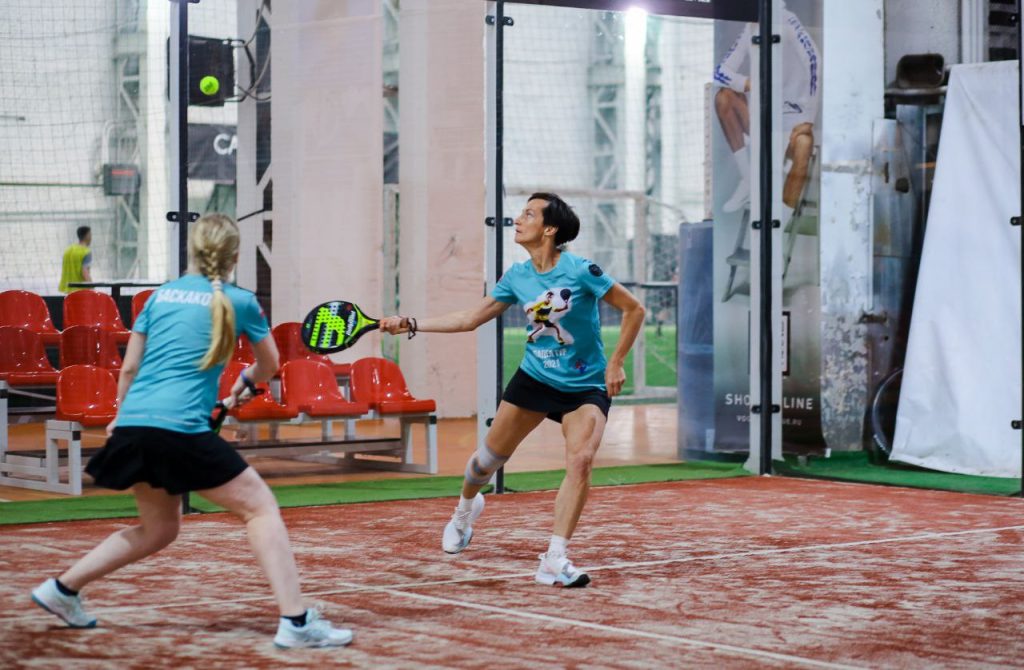
Your padel court says something every time a player walks past it. A plain court is a playing space. A custom court is a billboard, a brand statement, and a revenue asset rolled into one — club colors on the walls, a logo on the back glass, sponsor boards integrated into the structure.
The catch: custom doesn’t mean expensive-if-you-know-what-to-ask-for. This guide covers what is actually customizable (structure, glass, turf, branding, accessories), what drives the price up, and the questions to ask before you sign a custom project. We build custom courts in Hengshui, China (about our factory) — this is the conversation we’d have across a factory bench.
Key Takeaways
– Almost everything is customizable: glass tint and low-iron options, wall colors and powder-coating, turf (blue/green/red/black), court markings, gates, scoreboards, lighting, roofing, and custom branding.
– Branding on glass and turf is the highest-ROI customization — it turns the court into a permanent ad surface for sponsors and your club.
– Custom specs cost 5–15% more than standard — the premium is mostly engineering (new structural drawings, custom panels) and setup, not the materials.
– Lead time extends 2–4 weeks for true custom work (logo silk-screening, custom panel sizes, non-standard colors).
– The quality gate is documentation: a factory that does custom says “yes, and here’s the drawing” — a trader says “yes, we can do that” and disappears after deposit.
What Can Actually Be Customized?
Custom padel court projects split into four buckets. Knowing the buckets is how you spend money where it matters.
Structural customization. Court size stays 20×10 m (FIP standard) for competitive play — but that doesn’t stop customization: panoramic vs classic framing, powder-coat colors on steel (any RAL), roof structures (see our Covered Court guide), and portal designs for events.
Glass customization. Beyond 10 mm vs 12 mm thickness, you can specify low-iron ultra-clear glass for sightlines, silk-screened logos and numbering on panels, tinted glass, and custom hole patterns for banners. This is where most “wow” branding happens.
Turf & surface customization. Court color is a brand decision: clay-red, tournament blue, Wimbledon green, or your club’s colors. Custom-logo turf panels sit at the service boxes or center. Surface type (cushioned vs tournament-grade) affects both price and feel.
Accessories & integration. Electronic scoreboards with your sponsor loops, perimeter LED lighting tied to brand colors, gate branding, benches, ball catchers, and even sensor systems for app-connected courts.
| Customization Tier | Examples | Cost uplift |
|---|---|---|
| Cosmetic (colors, numbering) | RAL powder-coat, glass tint | +3–8% |
| Branding (logos, sponsor boards) | Silk-screened glass, logo turf | +5–12% |
| Structural (panoramic, roof, portals) | Framing changes, covered options | +8–20% |
| Integrated (scoreboards, LED, sensors) | Electronics & cabling | +10–25% |
Branding That Pays for Itself
The smartest customization play for clubs isn’t luxury finishes — it’s sellable brand surfaces.
- Back-glass sponsor boards: 8-10 panels per court visible from every angle, rentable to local businesses. A four-court club with two sponsor panels per court generates recurring income that often covers the custom premium within two years.
- Logo turf: your club crest at center court is in every photo and broadcast frame. It’s also the cheapest “permanent” branding you can buy.
- Color identity: a recognizable court color (think the blue courts of Madrid’s pro venues) makes your club identifiable in photos, social posts, and matches — free marketing every time a member posts.
For manufacturers exporting custom courts, the same logic applies on the B2B side: a bespoke demo court in a dealer’s market is the strongest sales tool they can own.
How a Custom Project Actually Flows
A custom court isn’t a different product — it’s a standard product with a configuration layer on top. Here’s the flow we run for every custom project:
- Brief & site data — your dimensions, climate, intended use (competitive, club, event), and brand assets.
- Engineering — CAD drawings, structural calculations for any non-standard framing, wind-load and glass-tolerance checks. This is the step traders skip — and the step that prevents most on-site disasters.
- Sample approval — for colors and logo rendering, before production starts.
- Production — standard panels plus your custom elements; every panel CNC-drilled, radiused, polished.
- Pre-shipment documentation — photos, drawings, packing list, certificates (EN 12150 / SGCC, structural calcs).
- Shipping & installation — container loading in our factory, optional installation supervision or turnkey team.
The rule we repeat to buyers: a custom court is 95% the same product with 5% configuration — anyone telling you it’s a fundamentally different, mystery-priced product is selling opacity.
Cost Breakdown: What You’re Paying For
Base court prices vary by market, so the useful signal is the premium structure, not an absolute number. On top of a standard classic court (structure, 10-12mm glass, turf, net, lighting-ready), expect:
- Colors everywhere (RAL steel, turf color, glass tint): +3–8%
- Logo work (glass silk-screening, logo turf): +5–12%
- Structural changes (panoramic conversion, roof, oversized portals): +8–20%
- Electronics (scoreboards, LED systems): +10–25%
Two cost traps to avoid:
- “Custom” panels for standard sizes. If your court is entirely FIP-standard, you don’t need custom glass — some suppliers charge “custom” prices for off-the-shelf work.
- Traders who add a layer. A custom project with a middleman means two margins and zero engineering responsibility. Factory-direct with documented engineering is both cheaper and safer.
Can I fully customize my padel court size?
No — for competitive and rental use, the court must stay FIP-standard (20×10 m playing area, 6m+ height clearance). Customization applies to materials, colors, branding, framing, and accessories, not the competitive dimensions. Semi-standard sizes exist for private/non-competitive use but hurt resale and tournament eligibility.
How much does a custom painted padel court cost?
Expect a 3–8% uplift over a standard court for full color customization (RAL powder-coated steel + colored turf), and 5–12% with logo branding on glass or turf. An absolute price range depends on your market and shipping zone — request a spec-based quote from the XTZ Padel team for your project.
Can I put my club logo on the glass?
Yes. Silk-screening logos on tempered glass back panels is a standard custom option, fully compliant with EN 12150 safety certification, visible from inside and outside the court, and a sellable sponsor surface.
How long does a custom court take?
Standard courts typically 4–6 weeks from deposit to shipment; true custom adds 2–4 weeks for engineering drawings, sample approval, and logo production. Plan 2–3 months end-to-end for a fully branded club build including site prep.
Is custom branding safe with tempered glass?
Yes — silk-screening uses ceramic frit fused into the glass before tempering, so the logo is part of the glass, not a surface coating. It doesn’t weaken the panel and survives years outdoors; we heat-soak all custom panels under EN 14179 for spontaneous-breakage risk.
Conclusion: Buy the Court, Keep the Brand
A custom padel court is the same engineering with your identity layered on top — and the identity is what makes the court marketable, rental-ready, and sponsor-funded. The premium is modest when you buy factory-direct, the risks are documentation, and the payoff compounds every time someone photographs your court.
Every option in this guide is configurable on our own custom padel court system, built factory-direct in Hengshui.
Start with the questions above, get drawings and certificates in hand, and request a customized court quote from the XTZ Padel team — we’ll spec the branding layer around your site and budget.