The most common question we hear from clubs planning their first courts: indoor or outdoor? It’s not a taste question — it’s a business question with a real answer, and the answer depends on your climate, your revenue model, and your site.
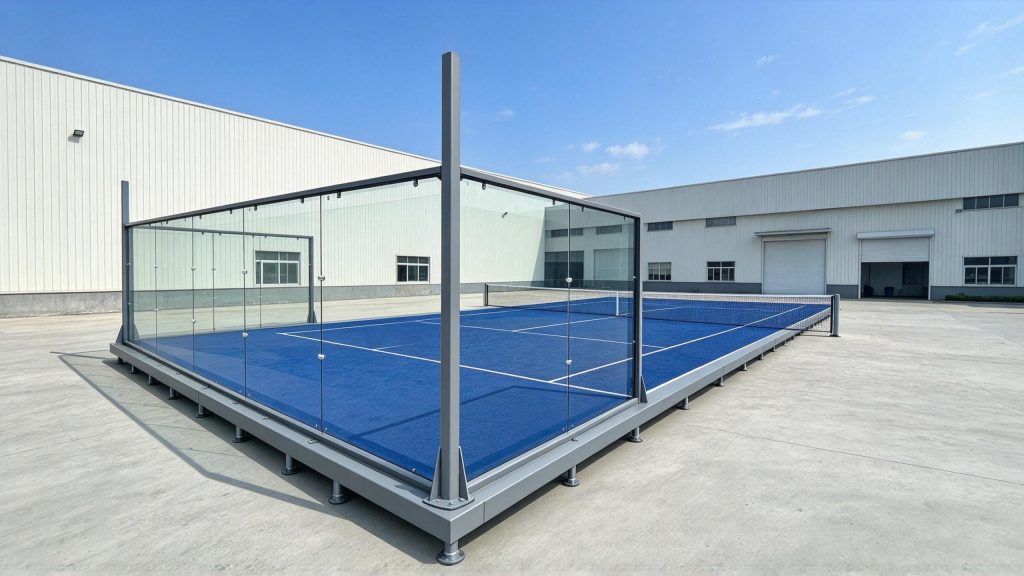
Outdoor courts are cheaper to build, faster to install, and work beautifully in mild, dry climates. Indoor (or covered) courts capture more playable hours in rainy or cold climates, command higher hourly rates, and protect the court’s lifespan. This guide lays out the trade-offs honestly — including when outdoor is the smart choice.
Key Takeaways
– Outdoor is cheaper and faster: typically 20-40% lower build cost and 2-4 weeks quicker to install; ideal for mild climates and land-rich sites.
– Indoor/covered wins on revenue in harsh climates: rain and cold erase outdoor bookings; covered courts capture those hours at premium rates.
– The “halfway” option is a covered court — a roof without full insulation. It captures most weather revenue at a fraction of full indoor cost (see covered courts).
– Climate is the deciding variable: above ~600mm annual rainfall or cold winters, indoor/covered usually wins the payback math.
– Hybrid models work: outdoor first to test demand, add covered/indoor courts as the club matures.
The Core Trade-Off: Cost vs Playable Hours
| Outdoor | Covered | Indoor | |
|---|---|---|---|
| Build cost | Baseline | +20-35% | +60-100%+ |
| Install time | 2-4 weeks | 3-6 weeks | 6-12 weeks |
| Playable hours | Weather-dependent | ~90% of daylight hours | 100%, climate-controlled |
| Hourly rate | Baseline | +10-20% | +30-60% |
| Court lifespan | 8-12 yrs (UV/weather) | 10-14 yrs | 12-15 yrs |
| Maintenance | More (UV, rain) | Moderate | Less |
The math is simple in two steps: (1) estimate how many hours per year your outdoor court would be unplayable (rain + extreme heat/cold), (2) multiply those hours by your hourly rate. If that number is bigger than the extra build cost of covered/indoor amortized over 10 years, the covered option pays for itself.
Climate Decides: A Quick Rule of Thumb
- Dry, mild climates (Mediterranean, desert, southern US): outdoor is usually the smart call — build more courts with the savings, capture the daylight hours.
- Rainy climates (UK, Nordics, coastal Asia): every rainy day is a lost booking; covered or indoor wins the payback math within 3-5 years.
- Very hot or very cold climates: the constraint shifts from rain to temperature. Covered courts with side screens or indoor with HVAC capture the midday/evening extremes.
The honest answer for most clubs: outdoor-first, covered-second. Start outdoor to test demand and cash flow, then add covered courts as utilization fills up. This de-risks the biggest capital decision (see how to start a padel club for the sequencing playbook).
What Outdoor Courts Actually Cost You (Beyond Build)
Outdoor courts hide costs in the operating column:
- Weather risk: rain stops play instantly; courts need 30-60 min drying time after showers (drainage design matters — see our surface guide).
- UV wear: outdoor turf and coatings age 20-30% faster; UV-stable materials are non-negotiable.
- Wind: strong winds disrupt play and stress glass fixings; wind-rated glass and structural checks are mandatory in exposed sites.
- Lighting: outdoor courts need more powerful, higher-mounted lighting for evening play (see padel court lighting).
What Indoor/Indoor Adds to the Budget
The premium buys more than a roof:
- Structure: steel portal frames, cladding, insulation (see our covered court guide for roof types and spec).
- Climate control: HVAC or at least ventilation + dehumidification (condensation ruins turf and steel over time).
- Lighting: indoor lighting is cheaper per court than outdoor (lower mounts), but adds to the electrical scope.
- Building codes: permits, fire safety, and insulation requirements — the biggest hidden cost and schedule risk.
Indoor courts also command higher rates because they’re playable in any weather — the revenue premium is the whole point.
The Hybrid Playbook (Recommended)
Most successful clubs don’t pick one — they sequence:
- Phase 1: Outdoor courts (2-4) to test demand with minimal capital.
- Phase 2: When utilization hits ~70-80%, add covered or indoor courts for the weather-proof hours.
- Phase 3: Add premium amenities (locker rooms, lounge, pro shop) funded by Phase 2 cash flow.
This approach matches capacity to proven demand, protects capital, and gives you data (members, hours, weather impact) before the big indoor investment.
Is an indoor or outdoor padel court better?
It depends on climate and business model. Outdoor is cheaper to build and ideal in mild, dry climates; indoor/covered captures more playable hours and premium rates in rainy or cold climates. For most clubs, outdoor-first with a covered option as demand grows is the safest path.
How much more does an indoor padel court cost?
Roughly 60-100%+ over an outdoor court for full indoor (structure, cladding, climate control), and 20-35% for a covered (roof-only) court. The premium pays back through weather-proof playable hours and higher hourly rates.
Can an outdoor padel court be used in winter?
Yes, but playability drops with rain, cold, and short daylight. In cold climates, covered or indoor courts capture the winter bookings that outdoor courts lose — often enough to justify the premium within a few years.
What is the lifespan of an indoor vs outdoor court?
Indoor courts typically last 12-15 years (protected from UV and rain); outdoor courts 8-12 years with proper UV-stable materials and maintenance. Maintenance cost is higher outdoors (see padel court maintenance).
Should I build outdoor or covered padel courts first?
Outdoor-first is the low-risk play: lower capital, faster installation, and it tests demand. Add covered/indoor courts once utilization fills, funded by the cash flow the outdoor courts generate.
Conclusion: Match the Court to the Climate and the Business
Indoor vs outdoor is a payback math problem, not a preference. Cheap outdoor courts in a rainy climate lose bookings weekly; expensive indoor courts in a mild climate sit empty. Know your climate, estimate your playable hours, and sequence the build to match proven demand.
Whatever you choose, spec the court right for its environment — UV-stable turf outdoors, proper drainage, wind-rated glass, and the right lighting. Talk to the XTZ Padel team about your site and climate, and we’ll help you pick the build that makes the numbers work.