

To start a padel club, you need roughly €250,000–€500,000 for a standard four-court facility, a location with about 1,000 m² of space, and a plan that treats the club as a community and coaching business — not just a rack of courts to rent. The biggest trap isn’t the money; it’s buying courts before you’ve built the player pipeline that fills them.
Padel is, by every measure, the fastest-growing racket sport in the world — 25 million+ players across 90+ countries, first-time retention above 90%, and a wave of new clubs opening monthly. That momentum pulls a lot of people in, and it pushes a lot of them to make one specific, expensive mistake: they buy the courts first and figure out demand second. Then the courts sit empty and the loan payments don’t.
This guide is the practical path — from the profitability question to the site, the costs, the revenue model, and the mistakes that sink first-time operators. We manufacture padel courts in Hengshui, China, and we’ve watched dozens of clubs launch (and a few fail), so the manufacturer’s view at the end is grounded in what actually accelerates a launch.
Key Takeaways
– A four-court club costs €250,000–€500,000 to start in Europe (more in the US, UK, and Australia, where labor, rent, and indoor fit-out dominate) — and indoor facilities cost far more than outdoor.
– Court rental is the base, not the business: the strongest clubs earn at least 20% of revenue from coaching, memberships, tournaments, and a café — and payback runs 2–4 years at healthy utilization.
– Utilization is the metric that decides everything: aim for 7.5+ booked hours per court per day, and fill “dead hours” (weekday mornings) with schools, seniors, and corporate groups.
– Start with the beginner funnel, not the court model: who teaches new players, how they join, and what happens after their first visit determines whether curiosity becomes a weekly habit.
– Phase your courts: launch with two or three, prove demand, then expand — a manufacturer can help you scale faster than building all six on day one.
Is a Padel Club Profitable?
The honest answer: yes, if it’s run as a community business — and no, if it’s run as a parking lot with walls.
The numbers that matter. A well-managed four-court club in a decent market can reach profitability in 2–3 years with net margins of 13–20% (strong operators push toward 25%). Payback typically lands in the 2–4 year window. At a healthy 7.5 booked hours per court per day, a four-court indoor club can generate €30,000–€33,000 per month ex-VAT — but that’s the ceiling, not the baseline, and it assumes you fill the courts.
The gap between profitable and not is utilization. A club averaging 5 hours per court per day struggles to cover fixed costs; 7–8 hours is healthy; 9+ is strong. The operators who succeed are the ones who fill the dead hours — weekday mornings and early afternoons — with schools, over-55s programs, and corporate bookings, rather than letting the courts sit dark between 10 am and 4 pm.
The market tailwind is real and it’s not going anywhere. Padel’s growth curve is still climbing, and in most markets the constraint is court supply, not player demand. But supply doesn’t guarantee your specific courts get booked — which is why the most important step before you start a padel club is building the player pipeline that will fill it, not buying the courts.
Business Model & Revenue Streams
The single biggest mistake new operators make is building a business around court rental alone. Court rental is the base; the money — and the resilience — comes from layering other streams on top.
Court rental is the backbone. Rates run €10–€30 per hour in most of Europe (higher in premium or indoor markets like Ireland’s €40–€54), booked by four players who split the cost. It’s steady, but it’s also capped by the number of hours in a day.
Memberships and subscriptions are where stability comes from. Monthly or annual packages with priority booking and preferential rates convert casual players into recurring revenue — and protect you from the weather and the seasons.
Coaching, group lessons, and clinics are the highest-margin stream and the retention engine. A club that teaches well keeps its players; a club that only rents loses them to whoever teaches better.
Tournaments and events generate outsized returns — an average event can turn over €15,000–€50,000 when you count rentals, concessions, and the pro shop. They’re also marketing: every tournament fills your calendar and your social feed.
The bar and pro shop can represent 15–25% of total turnover if run seriously. Padel is social; players stay for a coffee or a drink after the match, and that dwell time is revenue.
Corporate and hospitality bookings fill off-peak hours at premium rates. Team-building sessions, client events, and league nights turn your emptiest slots into your most profitable ones.
The “20% rule” from successful operators is the cleanest framing: at least 20% of revenue should come from non-rental sources. Below that, you’re a landlord, not a club — and landlords don’t build communities.
Site Selection & Court Planning
Where you build matters more than what you build, because location sets your rent, your permits, and your ceiling — and it’s the decision that determines whether starting a padel club in your market is even viable.
Space. A three-court facility needs roughly 1,000 m² — about 700 m² for the courts and 300 m² for reception, changing rooms, and circulation. Each court is 20×10 m, but the real footprint with structure and clearance is closer to 23×13 m, and you need 6–8 m of clear headroom indoors. For the exact numbers, see our padel court dimensions guide.
Indoor vs outdoor. Outdoor courts are cheaper to build (€40,000–€60,000 each vs €55,000–€80,000+ for indoor) but hostage to the weather and the seasons. Indoor courts cost more and book year-round — which is why, in cold or rainy climates, indoor is the stronger long-term model despite the higher upfront cost. In warm, dry markets, outdoor is often the smarter entry point.
Court count. Four courts is the widely cited sweet spot for profitability, but that doesn’t mean you build four on day one. Start with two or three, prove demand, then expand. A half-empty six-court facility bleeds money; a full three-court facility funds its own expansion.
Accessibility. Proximity to residential areas, parking, and public transport drives walk-in and repeat play. A great court in a hard-to-reach location is a great court nobody visits.
Startup Costs & Funding
Here’s what a padel club actually costs to launch, and how people pay for it.
The headline number. A standard four-court project in Europe runs €250,000–€500,000, and that’s the figure the brief and the industry keep circling. But it’s a range, and the spread comes from court type, indoor vs outdoor, location, and amenities:
| Cost line | Typical range |
|---|---|
| Courts (4 units, ~€50k each) | €160,000–€240,000 |
| Indoor building/fit-out (if indoor) | €100,000–€200,000+ |
| Locker rooms, reception, café | €50,000–€150,000 |
| Booking software & systems | €10,000–€20,000 |
| Permits, planning, professional fees | €20,000–€50,000 |
| Working capital (first 6 months) | €30,000–€80,000 |
The US equivalent is higher — $250,000–$490,000 for a lean outdoor club, exceeding $600,000 for indoor — because labor, rent, and fire-safety compliance cost more. The UK and Australia sit higher still.
Funding structure. Most clubs blend three sources: owner equity, a business loan or lease financing on the courts, and sometimes local sports-development grants or subsidies. The courts themselves are often financed separately from the building, because they’re movable, depreciable assets with resale value — a lender conversation that’s easier than financing fit-out.
The budget you can’t skip. Working capital for the first six months is the line first-timers underfund. Courts take months to fill, and fixed costs — rent, staff, utilities — start on day one. Undercapitalize the ramp-up and you’ll be forced into discounting just when you need to build the brand.
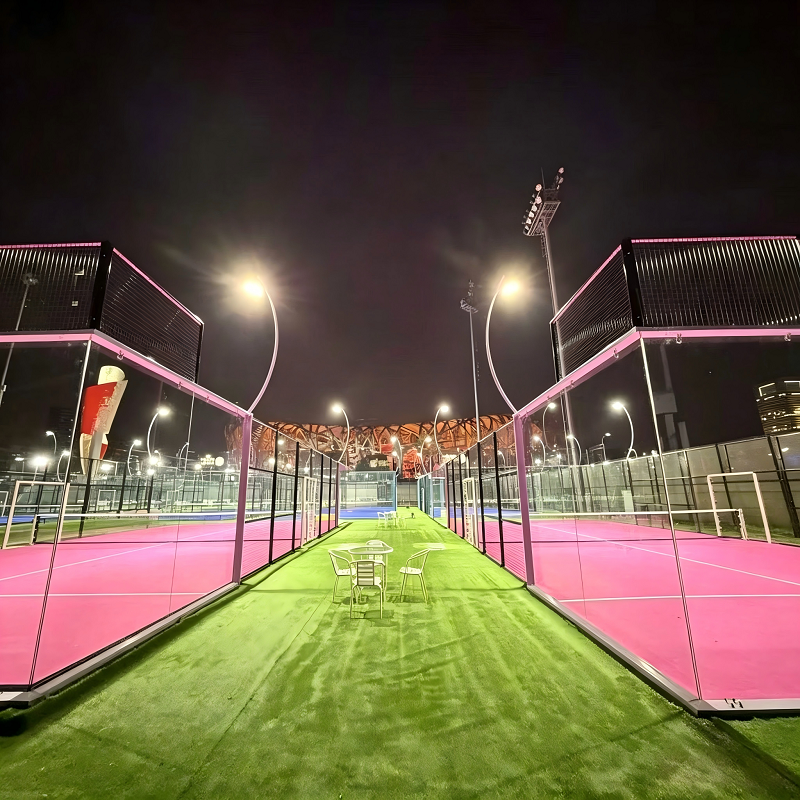
For a line-by-line look at what the courts themselves cost before the club wraps around them, see our padel court cost guide.
How a Manufacturer Helps You Launch Faster
Most “how to start a club” guides end at the business plan. This section is the part only a court manufacturer can write — because a good supplier does more than sell you steel and glass.
We help you pick the right court type, not the most expensive one. The first question isn’t “classic or panoramic?” — it’s “outdoor or indoor, and how many?” A manufacturer who builds all the formats can tell you honestly that a classic framed court is the value play for a first club, a panoramic court is the visibility play for a flagship venue, and a covered court is the climate play. Buying the wrong format is a five-figure mistake you make once.
We support phased expansion. The smartest launch path is two or three courts first, then grow. We design courts to be added incrementally, so your second phase bolts onto the first without tearing anything down. You buy capacity as demand proves it, instead of betting everything on day one.
We compress your timeline with turnkey delivery. Every week between signing and opening is a week of rent you’re paying without revenue. A manufacturer that handles the court, the foundation coordination, and the installation — and runs manufacturing in parallel with your site work — shaves months off your launch. That’s the difference between opening in the spring season and missing it. See our turnkey installation guide for the full process.
We’ve seen what works, and we share it. We’ve watched clubs launch in a dozen countries, and the pattern is consistent: the ones that succeed treat the club as a community with courts, not courts with a coffee machine. That’s not a sales pitch — it’s the difference between the clients we see expand in year two and the ones we see sell their courts.
Priya launched a three-court outdoor club in Bengaluru in 2025, against our advice to start with four. “You can’t fill four on day one here anyway,” she said — and she was right for her market. She started with three, packed them with a beginner academy and corporate leagues, and added her fourth court eleven months later, funded entirely by the first three’s revenue. “The manufacturer told me to phase,” she said. “It was the best advice in the whole project.”
If you’re planning a club, the first conversation should be about your market and your timeline, not a court spec. Talk to our launch team →
Common Mistakes to Avoid
Most failed padel clubs don’t fail on a spreadsheet; they fail on one of these six mistakes.
- Buying courts before building demand. The courts are the easy part. The hard part is the pipeline of players, coaches, and community that fills them. Build the waiting list before you pour the slab.
- Overbuilding on day one. Six courts with 40% utilization lose money; three courts at 90% fund their own expansion. Phase.
- Ignoring the “dead hours.” Weekday mornings are where profitable clubs separate from struggling ones. Schools, seniors, and corporate programs turn dead time into revenue.
- Running a rental business instead of a community. No coaching, no memberships, no café, no tournaments — just bookings. That’s a landlord model, and it has a hard ceiling.
- Undercapitalizing the ramp-up. Six months of fixed costs with no revenue is a real number. If you can’t fund it, you can’t survive long enough to fill the courts.
- Picking the wrong location. Rent that’s too high, access that’s too hard, or a market that’s already saturated. The best court in the wrong place is an expensive decoration.
How much does it cost to start a padel club?
A standard four-court club costs €250,000–€500,000 to launch in Europe, more in the US, UK, and Australia where labor and indoor fit-out cost more. That covers the courts, building or fit-out, amenities, permits, and six months of working capital. Indoor facilities run significantly higher than outdoor.
Is a padel club profitable?
Yes, when run as a community and coaching business. A well-managed four-court club reaches profitability in 2–3 years with net margins of 13–20%, and payback typically lands in 2–4 years. The key metric is utilization — 7.5+ booked hours per court per day is the healthy target.
How many courts should a padel club start with?
Start with two or three, not six. Four courts is the widely cited profitability sweet spot, but you should prove demand first and phase the expansion — a full three-court facility funds its own growth, while a half-empty six-court facility bleeds money.
What are the main revenue streams for a padel club?
Court rental is the base, but the strongest clubs layer memberships, coaching and group lessons, tournaments and events, a bar and pro shop, and corporate bookings on top. A good rule is that at least 20% of revenue should come from non-rental sources.
How long does it take to open a padel club?
Plan for several months from signing to opening. Court manufacturing takes 20–30 days, concrete needs 14–28 days to cure, shipping takes 15–45 days, and permits can run 2–8 weeks. Running the foundation in parallel with manufacturing is the biggest lever for a faster launch.
Conclusion: Build the Community, Then the Courts
Starting a padel club is a bet on a sport with real momentum — but momentum is a tailwind, not a guarantee. The operators who succeed are the ones who treat the club as a community business first: they build a beginner funnel before they build a facility, they phase their courts instead of overbuilding, and they layer coaching, memberships, and a café on top of court rental so one rainy week doesn’t sink the quarter.
The practical order is simple: validate demand, pick a location you can afford to fill, start with two or three courts, and fund six months of runway. Everything else — the glass, the turf, the lighting — is a decision you make after you’ve answered those four.
If your members are new to the sport, our guide on how to play padel is a good first read for beginners.
If you’re serious about launching, the court is the part we know best, and we’ll help you get the format, the phasing, and the timeline right without overselling you a single panel. Talk to the XTZ Padel team → and let’s build your launch plan together.