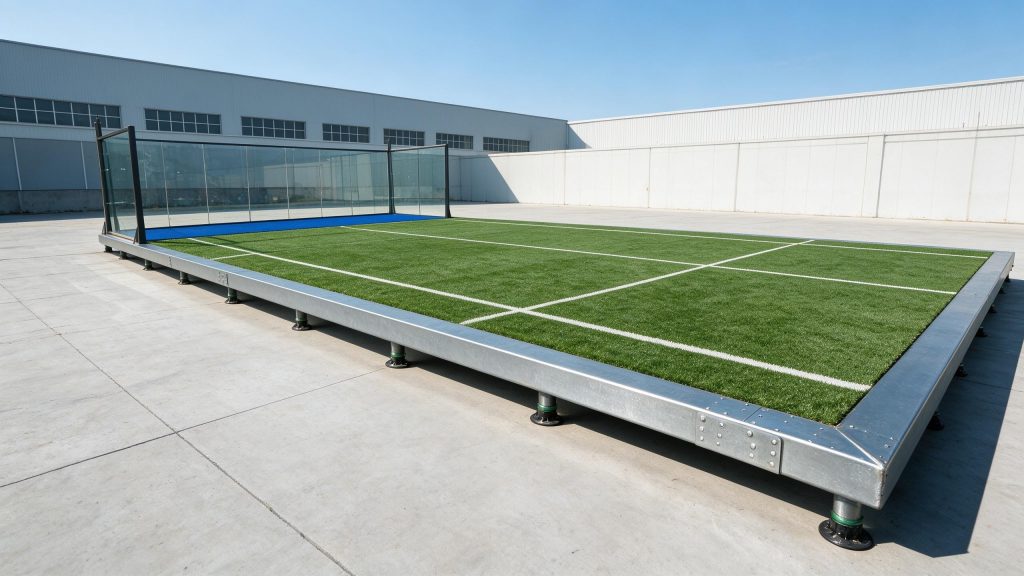
The surface is the second-most-important component of a padel court after the glass — and the one buyers most often under-spec. Play a tournament on a cheap, worn surface and you’ll feel it in every bounce: dead turf, uneven seams, slipping feet. Play on a properly specified surface and the game feels like the pro courts you watch on TV.
This guide covers the surface options (artificial turf is the standard; alternatives exist), what specs matter (pile height, infill, backing, drainage), how surface affects play, and what to demand from your supplier.
Key Takeaways
– Artificial turf is the padel standard — 10–13 mm pile height with sand infill (or rubber/sand mix), designed for lateral movement and true ball bounce.
– Specs that matter: pile height, fiber type (mono vs textured), infill weight (12–18 kg/m²), stitch rate, backing, and drainage.
– Two surface families: sand-filled (cheaper, durable, slightly slower) and performance/rubber-mix (faster, cushioned, premium feel).
– Color is brand + function: blue, green, red, or custom; UV-stable pigments are non-negotiable outdoors.
– Surface cost is typically 10–15% of the court budget — and surface life is 8–12 years with proper care (sand top-up, brushing, cleaning).
Why Artificial Turf Won
Early padel was played on tennis-style surfaces, but the sport standardized on artificial turf for three reasons:
- Consistent bounce. The ball’s rebound off turf is predictable — critical when walls and net control so much of the game.
- Lateral grip without traction lock. Turf grips during explosive side-steps but releases cleanly on slides, protecting knees and ankles.
- All-weather drainage. Quality turf drains fast, so courts dry quickly after rain — a business advantage for clubs (see our covered court guide for the all-weather upgrade).
Alternatives exist (acrylic/resin surfaces like cushioned tennis courts, and rubber systems), but for club and tournament padel, sand-filled artificial turf dominates the market — which means best price-performance and easiest replacement.
The Spec Sheet: What Actually Matters
| Spec | Typical | Why it matters |
|---|---|---|
| Pile height | 10–13 mm | Shorter = faster, harder bounce; taller = softer, slower |
| Fiber type | Mono (single filament) or textured | Textured holds infill better, more durable |
| Infill | Sand 12–18 kg/m² (or sand+rubber mix) | Weighs turf down, stabilizes footing; rubber adds cushion |
| Stitch rate | 3/8″ to 5/16″ | Denser stitching = more durable, better fiber stand |
| Backing | Dual-layer (PP + latex) | Prevents delamination in sun/rain |
| UV stability | 5000+ hrs | Outdoor colors don’t fade; fibers don’t embrittle |
| Drainage | Perforated backing, sloped base | No puddling, no standing water |
The two specs beginners ignore: infill weight (too little sand = turf moves, seams show) and UV rating (a cheap “turf” that fades to grey in a year is a false economy).
Surface Types Compared
| Surface | Bounce | Feel | Cost | Best for |
|---|---|---|---|---|
| Sand-filled turf (standard) | Medium, consistent | Firm, grippy | Baseline | Clubs, most venues |
| Performance/rubber-mix turf | Faster, slightly higher | Softer, cushioned | +10–20% | Premium clubs, tournaments |
| Acrylic/resin | Fast, tennis-like | Hard, slick | Variable | Covered courts, some indoor |
| Rubber floor | Medium | Cushioned, warm | +15–25% | Indoor, multi-sport venues |
For most buyers, the decision is between standard sand-filled turf and the performance upgrade. The performance turf’s cushioning pays off in member comfort (longer sessions, fewer joint complaints) — the premium is usually worth it for clubs whose members play 3+ times a week.
How the Surface Affects Play (and Your Booking Rate)
- Bounce speed shapes the game: a faster surface favors power and volleys; a slower surface extends rallies and favors placement — and rally length is what casual players love.
- Consistency is the retention killer: a surface with dead spots and bulging seams breaks the rhythm of every point. Buy from a supplier who installs on a properly leveled base.
- Drainage is the revenue killer: a court that stays wet for a day after rain loses bookings. Perforated turf + sloped base is the fix.
Installation & Base: The Part Nobody Talks About
The turf is only as good as the base beneath it. A padel surface sits on a concrete or asphalt base with a fall of ~0.5–1% for drainage. Common failures:
- Base not flat (puddles, turf wave).
- Base not cured before turf install (trapped moisture → mold/odor).
- Seams not glued/stitched properly (tear at the seam within months).
Demand: base flatness spec (≤3 mm over 3 m straightedge), drainage fall, and a written installation warranty on seams. The turf supplier and the base contractor must talk — turf can’t fix a bad base.
Cost & Lifespan
- Surface cost: typically 10–15% of total court budget (structure, glass, and net are the bigger line items).
- Lifespan: 8–12 years outdoors with maintenance; sand top-ups every 1–2 years, annual brushing and cleaning, UV exposure management.
- Maintenance cost is low but real: ~$200–500/court/year for infill top-up and cleaning (see our padel court maintenance guide for the full routine).
What surface is used on padel courts?
Artificial turf is the standard — sand-filled (or sand+rubber mix) turf with 10–13 mm pile, designed for lateral grip, consistent bounce, and fast drainage. Acrylic and rubber alternatives exist for indoor/premium venues.
What pile height is best for padel turf?
10–13 mm is the typical range. Shorter (10 mm) plays faster with a harder bounce; taller (12–13 mm) feels softer and slightly slower. Match it to your court’s level and the feel your members want.
How much does padel court turf cost?
Expect turf to be 10–15% of the total court budget. Premium performance turf (rubber-mix, cushioned) costs 10–20% more than standard sand-filled turf. Absolute prices depend on market and shipping.
Can you play padel on tennis court turf?
Technically you can mark a court, but tennis turf is wrong for padel: wrong pile height, bounce, and grip profile. Proper padel turf is worth the difference — the game feels and plays differently.
How long does padel turf last?
8–12 years outdoors with maintenance: sand top-up every 1–2 years, annual brushing/cleaning, and UV-stable materials. Indoor courts last longer (less sun and weather stress).
Conclusion: Spec the Surface, Keep the Members
The surface is the second-most-important component of a padel court after the glass — and the one buyers most often under-spec. Play a tournament on a cheap, worn surface and you’ll feel it in every bounce: dead turf, uneven seams, slipping feet. Play on a properly specified surface and the game feels like the pro courts you watch on TV.
Protecting that lifespan is mostly routine care: see the padel court maintenance guide for the quarterly and annual checklist.
Buy the specs, not the square meters: pile height, infill, UV rating, drainage, and a written base-and-seam warranty. And when you request a quote from the XTZ Padel team, ask for the surface spec sheet for your climate — we supply courts as one engineered system.