

Padel court glass is tempered (toughened) safety glass, typically 10 mm or 12 mm thick, certified to standards like EN 12150. It’s four to five times stronger than ordinary glass, shatters into blunt granules instead of shards, and — when specified and installed correctly — outlasts every other component of the court.
Glass choice also decides which court system you can build. A panoramic padel court, for example, leans the full structural load on 12 mm low-iron panes instead of back and side posts — which is exactly why glass quality matters even more on a glass court than on a classic one.
Mikael learned the other side of that sentence the expensive way. Six weeks after opening his four-court club in Sweden in 2024, a back-wall panel exploded into a million pebbles during a quiet Tuesday session. No ball had touched it. The culprit: an installer had torqued the fixing bolts far past spec, loading the glass with stress until a cold night finished the job. The replacement panel cost €400; the lost bookings and “is it safe?” questions from members cost far more.
His mistake is the industry norm, not the exception — and it’s avoidable. This guide covers how to choose between 10 mm and 12 mm, which certifications to demand, why glass really breaks, and the eight questions that separate serious suppliers from risky ones. We manufacture padel courts in Hengshui, China — consider this the conversation we’d have across a factory bench.
Key Takeaways
– 10 mm for indoor and budget projects; 12 mm for outdoor, commercial, and panoramic courts — 12 mm is now the de facto standard for commercial outdoor installs, and the UK’s LTA treats 10 mm as the minimum.
– Tempered glass is 4–5× stronger than annealed glass and breaks into blunt granules (per EN 12150) — the only acceptable material for padel enclosures.
– Around 90% of padel court glass breakages trace back to installation errors, not ball impacts — over-tightened bolts, missing gaskets, misaligned frames.
– Nickel sulfide inclusions can cause spontaneous breakage months after install; Heat Soak Testing (EN 14179) detonates defective panels at the factory.
– Always verify certificates, not claims: EN 12150 (tempering), EN 12600 (impact), EN 14179 (heat soak), and SGCC/ANSI Z97.1 for North America.
Why Do Padel Courts Use Glass Walls?
Padel courts use glass walls because the walls are part of the game: the ball must rebound off them predictably, and spectators must see through them. Glass delivers both — consistent rebounds across the entire back wall, and full visibility that turns every match into a viewing experience. It’s a defining feature of what makes padel unique among racket sports.
Early padel courts used concrete walls — cheap, durable, and about as inviting as a parking garage, with rebounds to match. When the sport professionalized in the 1990s — the International Padel Federation was founded in 1991 — tempered glass took over for three reasons:
- Rebound consistency. Glass is flat and uniform; every rebound behaves the same way, making the wall game learnable and fair.
- The “aquarium effect.” Transparent walls let spectators, coaches, and cameras see everything.
- Safety engineering. Modern tempered glass is a certified safety product, not a window pane. More on that next.
What Type of Glass Is Used in Padel Courts?
Tempered (Toughened) Safety Glass
Every legitimate padel court uses tempered glass. The process heats annealed glass past 600°C and blast-cools it, locking compressive stress into the surface. The result, defined by EN 12150, has two properties that matter:
- Strength: 4–5 times that of ordinary annealed glass. A properly installed panel withstands frontal impacts of 300 kg and more — players crashing into walls is routine.
- Breakage mode: when it does fail, it disintegrates into blunt-edged granules rather than dagger-like shards. Players walk away with a story, not stitches.
The catch: tempered glass is strong on its face and vulnerable at its edges and corners. Nearly every handling and installation rule in this guide exists to protect those edges.
Laminated & Heat-Soaked Options
Two upgrades sit above standard tempering:
- Laminated glass (typically 6+6 mm: two tempered lites bonded with a PVB interlayer) holds together even when broken — the panel stays in the frame instead of raining granules onto the court. Premium and high-traffic venues specify it for zero-downtime risk management.
- Heat-soaked glass has passed a Heat Soak Test (HST) under EN 14179: hours in a 290°C+ oven that forces nickel-sulfide-contaminated panels to shatter at the factory instead of on your court. Cheap insurance you should demand — details in the breakage section.
Low-Iron Ultra-Clear Glass
Standard float glass carries a faint green tint from its iron content — visible at panel edges and under floodlights. Low-iron (ultra-clear) glass removes most of that iron for near-total transparency, and is the standard choice for panoramic courts, broadcast venues, and any project where sightlines are the product. If you’ve watched a pro match and marveled at how the walls seem to disappear, that was low-iron glass.
10mm vs 12mm Padel Court Glass: Which Thickness Do You Need?
This is the most common question buyers ask — and the industry answer has converged: 10 mm for indoor and budget-sensitive projects, 12 mm for outdoor, commercial, and panoramic courts.
| Factor | 10 mm Tempered | 12 mm Tempered |
|---|---|---|
| Impact resistance | Meets standards; baseline for play | Roughly 20–30% higher impact resistance |
| Weight | ~25 kg/m² | ~30 kg/m² (a full panel is ~20 kg heavier) |
| Wind load tolerance | Adequate for indoor/sheltered sites | Required for exposed outdoor sites |
| Vibration & flex | More perceptible flex on hard impacts | Noticeably more solid, “dead” rebound feel |
| Relative cost | Baseline | Typically 15–25% higher per panel |
| Best for | Indoor clubs, budget projects, framed classic courts | Outdoor, commercial, panoramic, tournament venues |
Two reference points worth knowing. The UK’s Lawn Tennis Association (LTA) padel guidance treats 10 mm as the safety minimum and 12 mm as preferred. And across the commercial market in 2025–2026, 12 mm has quietly become the default for outdoor installs — the price gap is small against the total cost of a court.
One nuance buyers miss: thickness interacts with court design. A fully framed classic court carries loads through its steel structure, so 10 mm performs perfectly well. A panoramic court with no rear corner pillars asks the glass to do more structural work — hence 12 mm is effectively mandatory there. More below.
Want to see how glass specification fits into a complete court system? View the Classic Padel Court specifications →
Safety Certifications Buyers Should Verify
Here’s an uncomfortable fact from the supply side: any glass processor can say their panels are “tempered to European standard.” Certification is how you check. Treat this table as your acceptance checklist — a serious manufacturer answers every row with documentation, not adjectives.
| Standard | What it covers | What to ask for |
|---|---|---|
| EN 12150 (Europe) | Thermally tempered soda-lime safety glass — strength and fragmentation (granule count per 50×50 mm) | Test certificate per production batch; fragmentation test report |
| EN 12600 (Europe) | Pendulum impact classification for glass in buildings | Impact class rating (target: 1(B)1 or equivalent for sports enclosures) |
| EN 14179 (Europe) | Heat Soak Tested thermally tempered glass — nickel sulfide risk elimination | HST process records; declaration of 100% heat-soaked output |
| SGCC / ANSI Z97.1 (North America) | Safety glazing certification for the U.S. market | SGCC certification number, verifiable in the SGCC online directory |
| CE marking (EU) | Declaration of conformity with the above EN standards | CE label on panels + Declaration of Performance (DoP) document |
Why be pedantic? Because uncertified glass on a commercial sports facility is a liability position, not a saving. If a panel injures a player and your supplier can’t produce EN 12150 or SGCC documentation, the legal exposure lands on you. The certificate costs nothing extra from a reputable factory; its absence should end the conversation.
Why Does Padel Court Glass Break? (And How to Prevent It)
Tempered padel court glass almost never breaks from ball impacts — a padel ball doesn’t carry the energy. Breakages come from three real causes, all preventable.
Installation Errors Cause ~90% of Breakages
Industry experience attributes roughly nine out of ten breakages to installation, not use. The usual suspects:
- Over-tightened bolts. Fixings torqued past spec create point stress that grows with every temperature cycle. (This is what shattered Mikael’s panel on a cold Swedish night.)
- Missing or wrong gaskets. Glass must never touch metal directly; EPDM or neoprene gaskets at every contact point absorb vibration and thermal movement.
- Misaligned frames. An untrue frame loads panels unevenly, leaving glass under bending stress it was never designed for.
- No expansion gap. Panels need 3–5 mm of clearance. Jammed edge-to-edge, a hot afternoon does the rest.
Prevention is procedural: installation drawings, calibrated torque wrenches, trained crews — and a supplier who provides all three.
Edge Damage and Micro-Fissures
Tempered glass is vulnerable at its edges. A panel chipped in shipping or clipped against a steel upright can carry a micro-fissure for months before a temperature swing or body-check detonates it. These “time bombs” are why panels must arrive with edge protection, why installers inspect every edge, and why any panel with visible edge damage goes back in the crate — not in the frame.
Nickel Sulfide Spontaneous Breakage
The rarest and strangest cause: microscopic nickel sulfide (NiS) inclusions trapped in the glass melt. They change crystal structure over time, expand, and can shatter a panel spontaneously — months after installation, with no impact at all. It’s uncommon (roughly one panel in several tonnes), but “uncommon” is cold comfort when it’s your center court on a Saturday.
The industry’s answer is the Heat Soak Test (EN 14179): finished panels bake at 290°C+, forcing NiS-contaminated panels to fail in the oven rather than on your court. It adds modest cost and eliminates most spontaneous-breakage risk. For commercial venues, we’d call it non-negotiable.
Maintenance Checklist
Glass itself needs no maintenance — but its interfaces do. Every three months:
- Check fixing bolt torque (vibration loosens bolts; loose bolts let panels rattle against frames)
- Inspect gaskets for compression, cracking, or UV degradation
- Walk the perimeter and check panel edges for new chips
- Confirm expansion gaps stay clear of debris and hardened sealant
Fifteen minutes per court, four times a year, separates a glass system that lasts decades from a warranty claim.
Glass in Classic vs Panoramic Padel Courts
Glass specification isn’t one-size-fits-all — it follows the court’s structural design, and this is where a manufacturer’s view earns its keep.
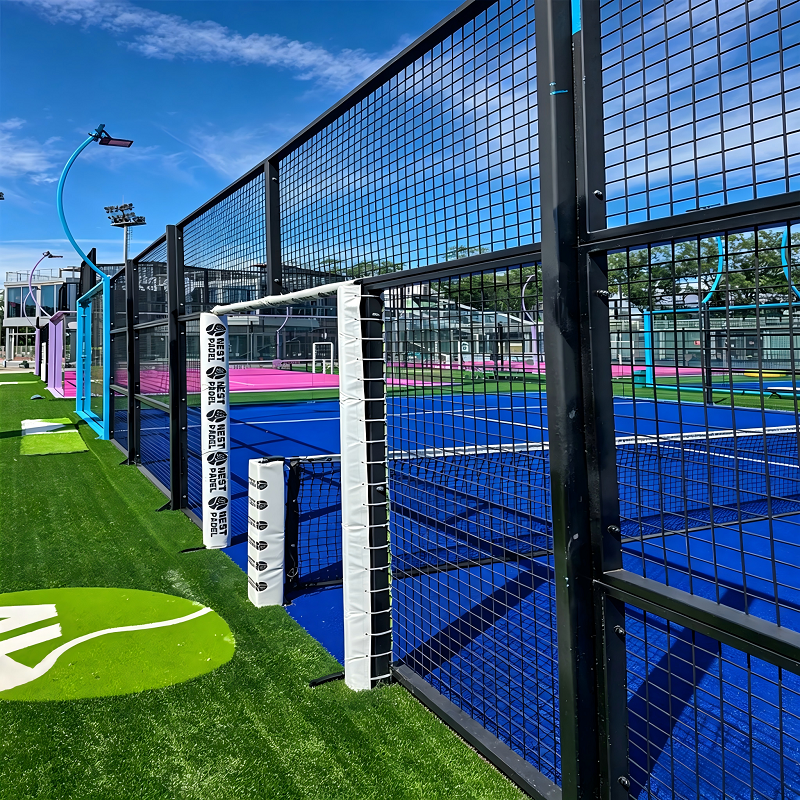
Classic (fully framed) courts carry structural loads through a steel pillar-and-beam frame. The glass fills the openings; the steel does the work. That makes 10 mm a perfectly sound specification, with 12 mm available for exposed outdoor sites. Standard panels measure 1995×2995 mm (with 1995×1995 mm uppers), and a full court uses 18 panels — each CNC-drilled with countersunk holes, radiused corners, and flat-polished edges so no raw edge ever meets a bolt. See the full assembly logic on our Classic Padel Court page.
Panoramic and super panoramic courts remove the rear corner pillars — in super panoramic designs, most of the visible side structure — for uninterrupted sightlines. With less steel carrying the load, the glass itself becomes structural: 12 mm is mandatory, low-iron ultra-clear glass is the expected standard, and hole-position and flatness tolerances tighten. These courts cost more for a reason: you’re buying engineering, not just transparency.
When Sofia, a procurement manager for a Middle East hotel group, specced a rooftop show court in 2025, she budgeted 10 mm glass to save roughly €2,000. One conversation about wind loads at elevation and panoramic sightlines later, she switched to 12 mm low-iron. “The saving would have been invisible,” she told us. “The glass wouldn’t have been.”
8 Questions to Ask Your Padel Court Glass Supplier
Print this list. Any supplier who hesitates on more than one of these is telling you something.
- Is your glass certified to EN 12150 — and can you send the test certificates? Certificates, not claims. For North America, ask for the SGCC number and verify it yourself.
- Is the glass Heat Soak Tested to EN 14179? If NiS spontaneous breakage isn’t on their radar, you don’t want their panels on your court.
- What gasket material and expansion-gap design do you use? You want to hear “EPDM or neoprene gaskets” and “3–5 mm clearance” without prompting.
- How do you pack for export? The right answer: A-frame steel racks, cork or rubber pads between panels, plywood crating. Transit edge damage is a top-three breakage cause.
- Do you provide installation drawings and technical support? With ~90% of breakages installation-caused, a supplier without documentation is selling you a problem.
- What does your warranty cover, and what’s the breakage replacement policy? Get replacement-panel logistics in writing before you sign.
- Can you customize — silk-screened logos, non-standard sizes, low-iron upgrades? A factory with real CNC and printing capability says yes instantly; a trader hesitates.
- What are your production lead time and delivery schedule? Glass is usually the longest-lead component of a court. Honest timelines here predict honest behavior everywhere else.
How thick is padel court glass?
Padel court glass is 10 mm or 12 mm thick. 10 mm suits indoor and budget projects with framed structures; 12 mm is the standard for outdoor, commercial, and panoramic courts. The UK’s LTA treats 10 mm as the minimum and 12 mm as preferred.
Can padel court glass break?
Yes, but rarely from play — tempered glass withstands frontal impacts of 300 kg or more. Around 90% of breakages stem from installation errors; the rest from edge damage or, rarely, nickel sulfide inclusions, which Heat Soak Testing (EN 14179) prevents.
Is 10mm or 12mm glass better for outdoor courts?
12 mm. Outdoor courts face wind loads, temperature swings, and heavier public usage; 12 mm offers roughly 20–30% greater impact resistance and better rigidity for a modest premium. For panoramic courts, 12 mm is effectively mandatory.
How many glass panels does a padel court have?
A standard court uses 18 tempered panels, typically 1995×2995 mm and 1995×1995 mm, with CNC-drilled countersunk fixing holes, radiused corners, and polished edges.
How much does padel court glass cost?
It depends on four variables: thickness (12 mm runs roughly 15–25% above 10 mm), glass type (low-iron and laminated cost more), certifications (heat-soaked panels add a modest premium), and order volume (a full 18-panel set prices very differently from single replacements). Any supplier quoting before asking these four questions is guessing. Request a specification-based quote from our team →
Replacing Padel Court Glass: What to Expect
At some point a panel will need replacing — a vandalised back wall, a forklift in a storage yard, or a breakage that traces back to a bad install. Replacement is straightforward if the original court was documented, and a long, expensive detour if it wasn’t.
Replace one panel, not the wall. Padel glass is modular: every panel is an individual tempered unit, so a damaged back or side panel comes out on its own. You don’t strip the court.
The replacement has to match the original spec exactly. Three things must line up:
- Thickness — 10 mm and 12 mm panels are not interchangeable in the same frame. The gasket channels, bolt holes and wind-load calculation are all built around one thickness.
- Type and certification — tempered to EN 12150 (or SGCC for North American projects), with the same hole pattern, and any tint or silk-screening matched to the neighbouring panels.
- Dimensions — corner panels, door panels and standard panels differ. A wrong-radius corner unit will not seat, no matter how carefully it’s carried in.
Lead time is the real cost, not the glass. The panel itself is quick to manufacture; the delay is almost always documentation and freight. Clubs that keep the original drawings, panel schedule and certificate pack on file can order a single replacement and have it installed in weeks. Clubs without that paperwork end up measuring panels on site and waiting on a re-engineering cycle. It’s why we ship every court with its drawings and panel schedule — and why we keep specs on file for courts we’ve built.
Install it like the first time. Roughly nine out of ten breakages come from installation rather than use, so the fitting matters as much as the panel: gaskets at every glass-to-metal contact point, 3–5 mm expansion clearance, and bolts torqued to spec instead of “tight.”
Need a replacement panel, or a spec check on a court you already own? Send us the drawings or the panel measurements and we’ll tell you straight whether we can match what you have.
Conclusion: Glass Isn’t an Accessory — It’s the Safety System
The glass walls are what make a padel court a padel court — the rebound engine, the spectator window, and the component players collide with at full speed. Treating it as a commodity line item is how projects end up with undocumented panels, exploded back walls, and liability nobody budgeted for.
The playbook is simpler than the industry makes it look: 12 mm tempered for outdoor and commercial builds, EN 12150 + EN 14179 certificates in hand, gaskets and expansion gaps done right, and a supplier who answers all eight questions without flinching. That’s the whole game.
If you’re speccing a court now, we’ll spec the whole system around your site, surface, and climate — request a quote from the XTZ Padel team →. We build the courts, heat-soak the glass, and answer question two with paperwork.