
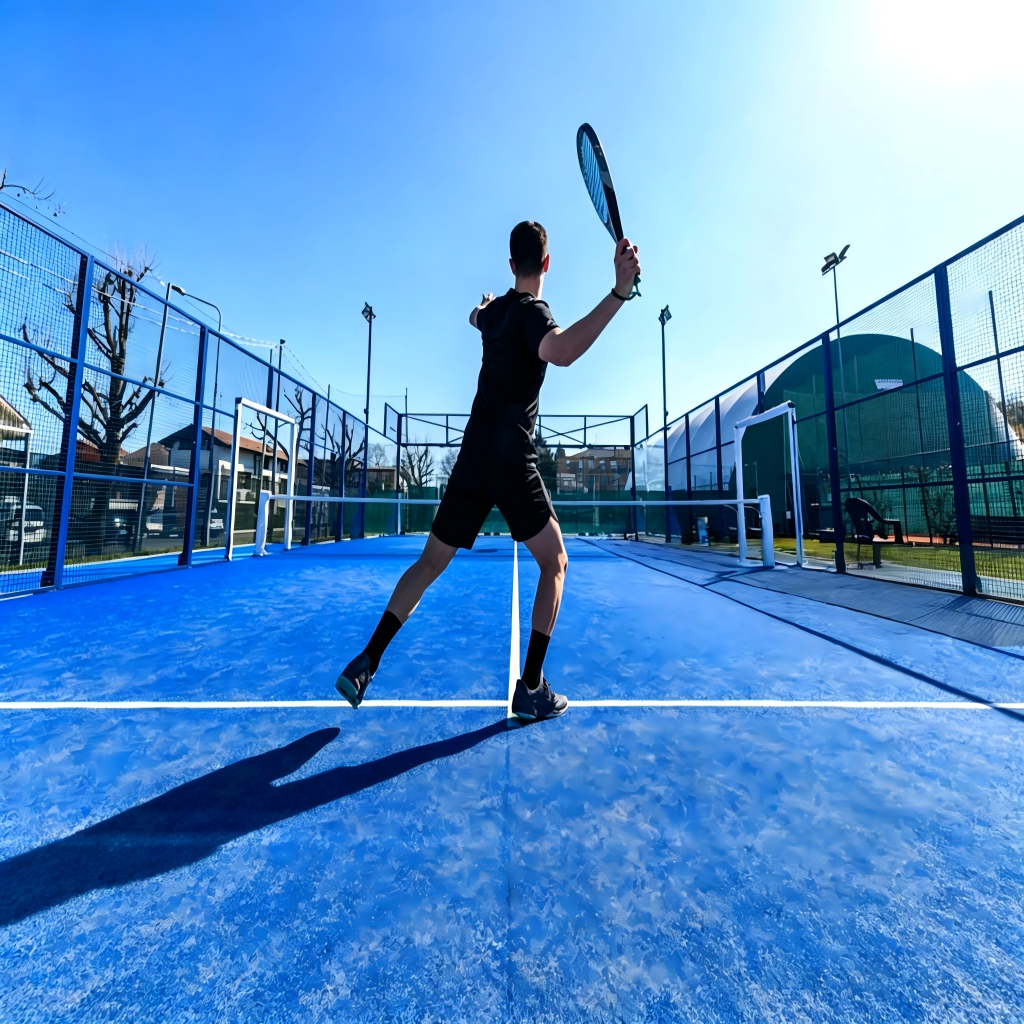
Padel, pickleball, and tennis differ in five fundamental ways: court size, walls, rackets, balls, and scoring. Tennis is played on a 23.77 m open court with strung rackets, padel on a 20×10 m glass-enclosed court with solid perforated rackets, and pickleball on a compact 13.4×6.1 m court with composite paddles and a perforated plastic ball.
If you’re trying to decide which sport deserves your time — or your club’s next investment — the padel vs pickleball vs tennis debate has never been more relevant. In 2025, something telling happened: pickleball’s U.S. search interest dropped roughly 10% while padel hit an all-time high on Google Trends, and searches for “padel vs pickleball” jumped 84% year over year.
You’ve probably felt the confusion yourself. A friend invites you to “paddle” — and you have no idea whether they mean the glass cage, the plastic wiffle ball, or a kayak. This guide settles it. We’ll compare court dimensions, equipment, rules, learning curves, and calorie burn — and then go somewhere no other comparison goes: a court builder’s view of what each sport costs in space and money. We manufacture padel courts for a living, so that last part comes from the factory floor, not a forum thread.
Key Takeaways
– Court size is the biggest practical difference: one tennis court footprint (~670 m² with runbacks) fits roughly three padel courts or four pickleball courts — a decisive factor for clubs and developers.
– Pickleball is the easiest to learn (rallies within one session), padel sits in the middle, and tennis has the steepest learning curve.
– Padel burns the most calories per minute: ~400–450 kcal per 40-minute session vs ~250 kcal for pickleball, thanks to longer rallies and constant movement.
– Momentum is shifting: pickleball has 13.6–19.8M U.S. players but cooling search interest, while padel has 25M+ players across 90+ countries and grew its U.S. court count from under 30 (2020) to 600+ (2024).
– Padel is the only one of the three where the walls are part of the game — the glass enclosure changes tactics, extends rallies, and drives most of the construction cost.
Padel vs Pickleball vs Tennis at a Glance
Here’s the 30-second answer to the difference between padel and pickleball — and where tennis fits in:
| Factor | Tennis | Padel | Pickleball |
|---|---|---|---|
| Court size | 23.77 × 10.97 m (doubles) | 20 × 10 m, enclosed | 13.4 × 6.1 m |
| Walls | None | Glass + mesh, in play | None |
| Racket | Strung, 68–73 cm | Solid, perforated, ~45 cm | Solid composite paddle |
| Ball | Pressurized felt | Lower-pressure felt | Perforated plastic |
| Serve | Overhead, full power | Underhand, below waist | Underhand, below waist |
| Scoring | 15-30-40, sets | 15-30-40, sets (as tennis) | Rally to 11, win by 2 |
| Standard format | Singles or doubles | Doubles (almost always) | Singles or doubles |
| Rally pace | Fast, open court | Slower ball, longer rallies | Quickest exchanges at net |
| Learning curve | Steepest (years to master) | Moderate (weeks to rally) | Gentlest (one session) |
| Global players | ~87M (ITF estimate) | 25M+ across 90+ countries (FIP) | 13.6M+ in the U.S. alone (SFIA) |
Curious what those glass walls actually look like up close? Explore our classic padel court →
Court Size and Playing Environment
Tennis: The Full-Size Classic
A tennis court measures 23.77 m long and 10.97 m wide for doubles — and that’s just the playing lines. Add the runback space behind the baselines and along the sides, and a single outdoor tennis court occupies roughly 36.6 × 18.3 m, or about 670 m² of land.
That footprint is tennis’s hidden cost. The game demands space to sprint, which is exactly why points are athletic and explosive — and why clubs in dense urban areas struggle to add capacity.
Padel: The Glass-Walled Arena
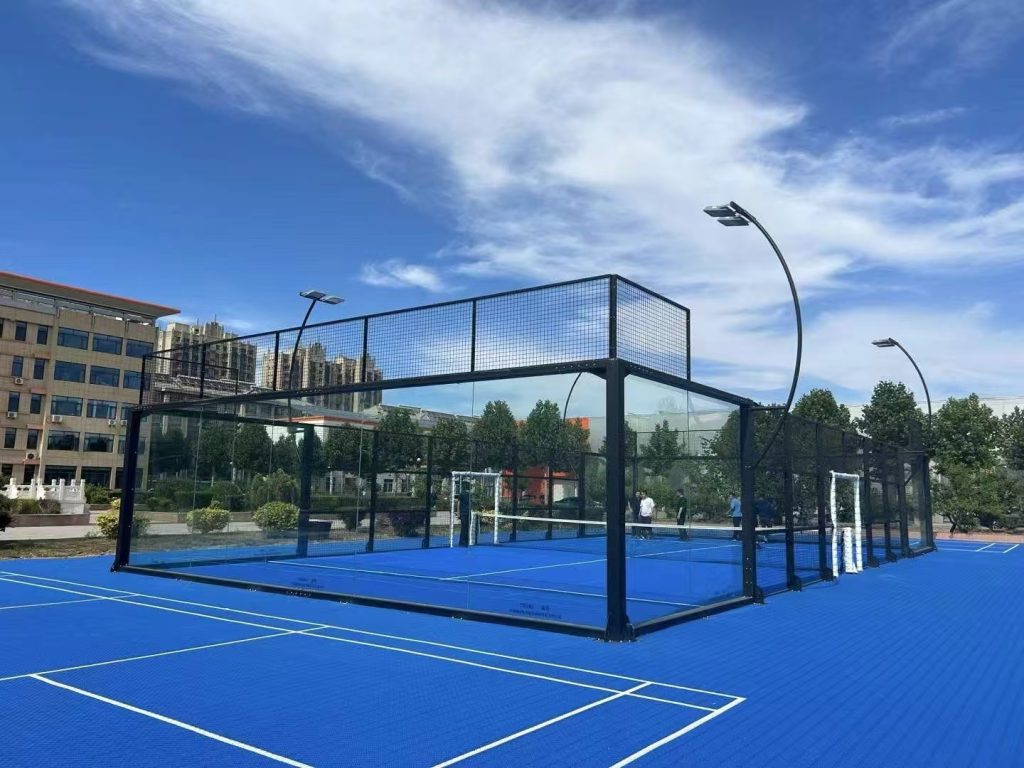
A padel court is 20 × 10 m, fully enclosed by glass back walls and a mix of glass and steel mesh on the sides. The walls aren’t boundaries — they’re part of the game. A ball that passes you can rebound off the glass and stay in play, which produces the long, tactical rallies padel is famous for.
The enclosure does three things at once: it keeps rallies alive, it compresses the game into a third of a tennis court’s footprint, and it turns matches into spectator theater — viewers can stand centimeters from the action. There’s real engineering behind why padel courts use glass walls, from tempered-glass safety standards to rebound consistency, and it’s a bigger topic than most players realize.
Pickleball: The Compact Court
Pickleball plays on a 13.4 × 6.1 m court — the same footprint as a badminton court. It’s small enough that four pickleball courts fit inside one tennis court, which explains the sport’s explosion across American parking lots, gyms, and converted tennis facilities.
The trade-off: no walls, no rebounds, and a 2.13 m “kitchen” (non-volley zone) at the net that forbids smashing from close range. The kitchen is what makes pickleball a game of dinks and patience rather than raw power.
Can you play padel on a pickleball or tennis court? Short answer: no on a pickleball court, yes-with-construction on a tennis court. A pickleball court is far too small and has no walls — padel is unplayable there. A tennis court, however, is an ideal host: its footprint fits two to three padel courts, and conversions are one of the most common projects we see from clubs. But you can’t play padel on a tennis court as-is, because without the glass enclosure the defining mechanic of the sport disappears.
Equipment: Rackets, Paddles, and Balls
The fastest way to tell the three sports apart is to look at what’s in a player’s hand.
Tennis uses a strung racket up to 73.7 cm long, strung at 20–30 kg of tension, paired with a pressurized felt ball. The strings store and release energy — which is why generating your own power is both tennis’s biggest thrill and its biggest barrier.
Padel uses a solid, perforated racket (maximum 45.5 cm, no strings) with an EVA foam core and a carbon or fiberglass face. The ball looks like a tennis ball but carries lower internal pressure, so it travels slower and bounces lower — deliberately tuned for rallies in an enclosed space. Because the racket is short and solid, control comes quickly; spin and touch take longer.
Pickleball uses a composite or graphite paddle — essentially an oversized table-tennis bat — and a perforated plastic ball that behaves like a hardened wiffle ball. The plastic ball barely bounces and kills pace, which is why pickleball rewards placement over power and is playable by almost any age group on day one.
Rules and Scoring Systems Compared
Tennis and padel share identical scoring: 15-30-40, deuce, six games to a set. If you can keep score in tennis, you can keep score in padel.
The serves, though, couldn’t be more different. The tennis serve is the most technically demanding shot in racket sports — an overhead motion players spend years refining. Padel removes that barrier entirely: the serve is underhand, struck below waist height after a bounce. It’s a rally starter, not a weapon. And once the ball is in play, padel’s glass walls remain live — you can play the ball off your own back glass, and your opponent’s shots can rebound back into play.
Pickleball invents its own logic. Games go to 11 points (win by 2), only the serving side historically scored (rally scoring variants are spreading in 2026), and the serve is underhand with a bounce. The non-volley zone forbids smashing at the net, forcing the patient “dink” exchanges that define high-level play.
Which Sport Is Easiest to Learn?
Learning curve, ranked: pickleball < padel < tennis.
Pickleball is the gentlest entry point in racket sports. The light paddle, slow plastic ball, and small court mean complete beginners rally within their first hour. It’s the main reason the sport conquered American retirement communities before it conquered everyone else.
Padel sits in the middle — and this surprises people, because it looks intimidating inside the glass cage. In practice, the underhand serve, short racket, and forgiving low-pressure ball let most beginners sustain rallies within two or three sessions. The walls feel like a bonus at first (mistakes stay in play) and only become a tactical puzzle at intermediate level.
Tennis is the steepest climb. The serve alone filters out casual players for months, and open-court movement demands real footwork before rallies become consistent.
Marta, a 52-year-old former club tennis player from Madrid, hadn’t held a racket in eleven years when her daughter dragged her to a padel court in 2024. She was rallying within twenty minutes. “In tennis I spent two summers learning to serve,” she told us. “In padel I was playing points before I’d even learned the rules.” Her story is typical — and it’s a big reason padel retains newcomers so well.
Padel vs Pickleball vs Tennis: Physical Demands and Health Benefits
Don’t let padel’s easy entry fool you — at match intensity it’s the most demanding of the three per minute played. A 40-minute padel session burns roughly 400–450 kcal, versus about 250 kcal for pickleball over the same span. Longer rallies, constant lateral movement, and almost no dead time between points do the work. Tennis sits between the two for singles, and closer to pickleball for casual doubles.
On joints, the ranking flips. Pickleball’s small court is the kindest to knees and hips — little sprinting, low impact. Padel involves constant short bursts and direction changes, but on a forgiving artificial-turf surface and at a smaller scale than tennis. Tennis is the hardest on the body: full sprints, hard stops, and the serve’s rotational load on shoulders and backs.
Age fit follows naturally: pickleball welcomes 60+ beginners, padel suits 8-to-70 doubles play, and tennis rewards those who started young — though it punishes late starters the most.
The Social Factor: Why Padel Is Doubles-First
Padel is almost always played in doubles — the 20×10 m court is deliberately sized for four. That’s not a limitation; it’s the product. Four players per court means a built-in social unit, constant communication, and a game where reading your partner matters as much as hitting winners.
Pickleball’s social engine is different: open-play culture. Show up alone at a public court, rotate in, meet twelve strangers before lunch. Tennis, by contrast, is often the loneliest of the three — finding a matched singles opponent, booking a full-size court, and committing two hours is real friction.
For clubs, this isn’t trivia. Four paying players per 200 m² is a fundamentally different business than two players per 670 m² — which brings us to the numbers.
Global Growth in 2026: Where Each Sport Is Winning
The participation data tells a story of two rockets at different altitudes.
Pickleball remains America’s participation giant: 13.6 million U.S. players by SFIA’s 2025 count (nearly 19.8 million by broader 2024 measures). But the curve is flattening — U.S. search interest fell about 10% in 2025 per Google Trends, and the facility land-grab phase is maturing.
Padel is the global growth story. The International Padel Federation counts over 25 million players across 90+ countries. Spain alone has 15,000+ courts; the UK went from 6,000 players in 2020 to 90,000 by 2023 (LTA/Playtomic data). In the U.S., courts grew from fewer than 30 in 2020 to over 600 in 2024, with USPA membership compounding at roughly 85% annually. Industry surveys consistently cite first-time player retention above 90% — the highest stickiness in racket sports.
Tennis, meanwhile, holds its ~87 million global players steady — not growing explosively, but not declining either. The interesting 2026 trend is the crossover: tennis players transition to padel far more smoothly than to pickleball, because scoring, ball feel, and net play transfer directly. Clubs increasingly treat padel not as tennis’s competitor, but as its retention tool.
From a Court Builder’s Perspective: Space, Cost, and ROI
Every other padel vs pickleball vs tennis comparison online is written from the player’s side of the net. We build these courts, so here’s the view from the other side.
Land efficiency. One tennis court with proper runbacks consumes ~670 m². That same footprint fits three padel courts — twelve players instead of four. Pickleball fits four courts, but at far lower revenue per booking in most markets.
Build cost. Pickleball is the budget option by a wide margin: lines, nets, and a decent surface on existing asphalt can cost a few thousand dollars per court. Padel is a genuine facility investment — steel structure, tempered glass, artificial turf, and lighting — running into the tens of thousands per court. Tennis sits in between, but with the worst space economics of the three.
Revenue per square meter. This is where the math flips. A padel court earns from four players at a time, books in 90-minute slots, and — per operator reports — holds utilization rates tennis courts rarely reach. Clubs converting one underused tennis court into three padel courts routinely multiply the booking hours generated by the same land.
Daniel, who runs a racquet club outside Austin, made exactly that call in 2024. He sacrificed one of his four tennis courts — the one with a cracked surface and chronic no-shows — and installed three padel courts. Within eight months, those three courts were generating more booked hours than his remaining tennis courts combined, and a third of the padel bookings came from members who hadn’t visited the club in over a year. “I didn’t lose tennis members,” he says. “I got back the ones tennis had already lost.”
If you’re weighing the same decision — club, hotel, or residential development — the spec sheet is the honest place to start. See how our classic padel court is engineered and priced →
Is padel easier than tennis?
Yes, for most beginners. Padel removes tennis’s two hardest barriers: the overhead serve (padel serves are underhand, below the waist) and open-court court coverage (the padel court is a third of the size). Most newcomers sustain rallies within two or three sessions, versus months in tennis.
Is padel the same as pickleball?
No — they share only a solid-stringless racket. Padel is played on a 20×10 m glass-enclosed court with a low-pressure felt ball and tennis scoring; pickleball uses a 13.4×6.1 m open court, a perforated plastic ball, and 11-point games. Padel is closer to tennis; pickleball is its own sport entirely.
Can you play padel on a pickleball court?
No. A pickleball court is too small (13.4×6.1 m vs padel’s 20×10 m) and has no walls, and padel’s defining mechanic — playing rebounds off the glass — is impossible without the enclosure. A tennis court, by contrast, can be converted to host two or three padel courts.
Which burns more calories, padel or pickleball?
Padel, clearly: roughly 400–450 kcal per 40 minutes of match play versus about 250 kcal for pickleball. Longer rallies and constant lateral movement make padel the more intense workout, while pickleball is gentler on joints.
Can tennis players switch to padel easily?
Very easily — easier than switching to pickleball. Scoring is identical, the felt ball feels familiar, and volley technique transfers directly. The main adjustments are learning to use the walls and softening the swing, since the solid racket and enclosed court reward placement over power.
Conclusion: Which One Should You Choose?
The padel vs pickleball vs tennis question has no universal answer — but it does have a personal one:
- Choose pickleball if you want the fastest, cheapest, most joint-friendly entry into racket sports.
- Choose tennis if you love open-court athleticism and accept the long technical climb.
- Choose padel if you want the best mix of social play, workout intensity, and fast progress — or if you’re a club looking at the strongest growth and retention numbers in the industry.
Still comparing the enclosed-court sports? Our breakdown of padel vs squash puts the wall mechanics, learning curve, and revenue math side by side.
The momentum is hard to ignore. Pickleball proved the world was hungry for accessible racket sports; padel is what happens when that accessibility meets real depth.
And if your interest goes beyond playing — if you’re wondering what a court would look like at your club, hotel, or development — that’s literally our day job. Talk to our court specialists → We’ll walk you through footprint, specs, and realistic budgets, no strings attached (unlike a tennis racket).