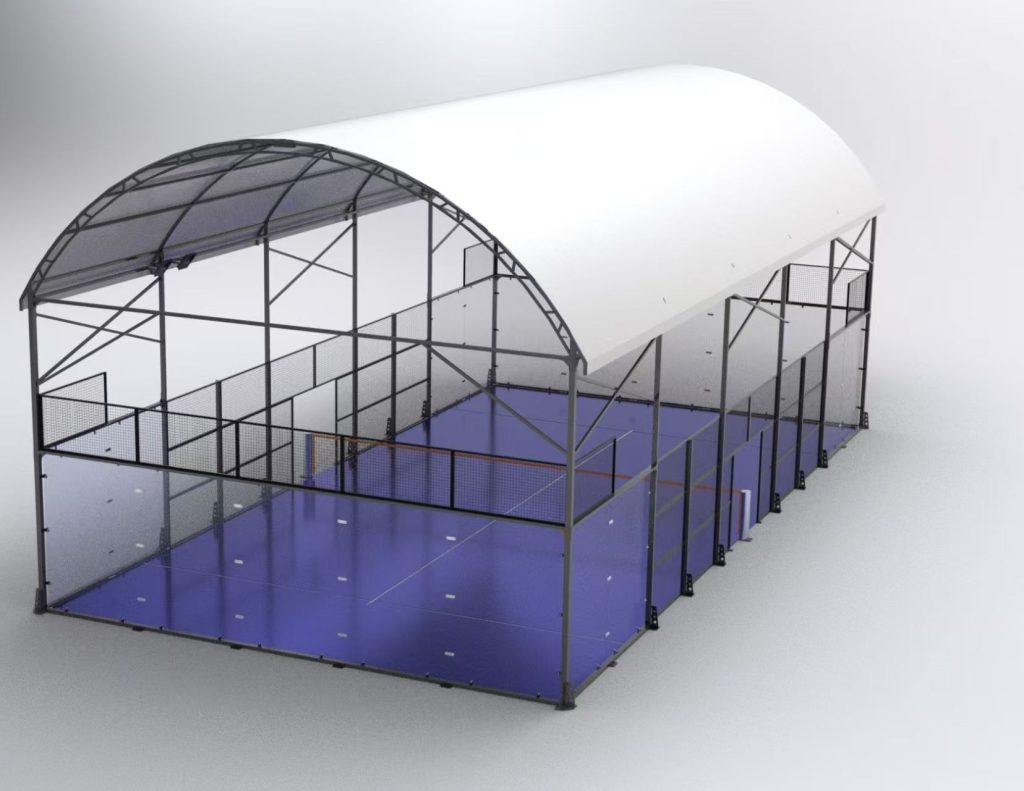
A padel court roof should be selected around clear height, local wind and snow conditions, drainage and the full installation scope. For private estates and clubs, choose the structure and court layout together rather than treating the canopy as an accessory.
Choosing a Curved or Other Roof Form
A curved roof can direct rainwater toward both sides; a mono-pitch roof concentrates collection on one edge. The best form depends on the available span, support positions, site boundaries and drainage route. Shape alone does not establish structural capacity or price.
Compare our covered court and curved roof configurations. Decide early whether you need an open-sided canopy or a climate-controlled indoor building, as their scope and operating requirements differ.
Clear Height and Structural Design
The FIP Rules of Padel require at least 6 m clear height throughout the court and recommend 8 m for new facilities. Measure to the lowest obstruction, including beams and lighting, rather than the roof ridge.
Ask for site-specific structural drawings and calculations covering the frame, bracing, anchors and foundations. A wind claim is meaningful only with its code, averaging period, return period and exposure basis. Do not compare figures expressed on different bases as if they were equivalent.
For an existing court, review the foundations, structural condition and clearances before adding a canopy. Roof or raised sites also need review of the supporting structure.
Curved Roof Drainage
Plan the whole water route: roof surface, gutters or valleys, downpipes and an approved ground discharge point. Size collection and outlets for the local rainfall and roof catchment. Keep discharge away from playing areas, entrances and foundations.
The base still needs drainage for wind-driven rain and condensation. Agree condensation control, maintenance access and safe snow-drop areas where relevant. Avoid copying generic gutter spacing or slopes into a different design.
Prefabrication and Installation
Confirm the drawing revision, component schedule and assembly method before production. The site programme should cover prepared foundations, unloading, lifting, frame assembly, covering, drainage connections and handover.
Production, shipping, local approvals and installation are separate stages. Ask for a programme based on the destination and site readiness; use the installation guide to assign responsibilities.
Roof Cost: Compare the Same Scope
First establish whether the price is for the roof only or the court and canopy together. A court kit price does not prove that the roof, foundations or local work are included.
- Supply: frame, covering, connections, gutters and downpipes.
- Site work: foundations, anchors and drainage connection.
- Delivery: freight, unloading, lifting and installation.
- Documentation: drawings, local design review and handover records.
Compare maintenance access, roof-cover replacement and the agreed warranty alongside the initial price. Final cost depends on span, loads, materials, destination and scope.
Quick answers
Can an existing court be covered?
Possibly, after reviewing the court layout, foundations, anchors, structural condition, clear height and drainage.
Does a curved roof cost more than a flat roof?
Shape alone does not decide cost. Compare itemised proposals for the same span, load basis, materials, foundations and installation scope.
Does the playing surface still need drainage?
Yes. Wind-driven rain and condensation can reach an open-sided covered court; agree the base drainage separately from roof runoff.
Send XTZ Padel your location and site drawing, including boundaries, entrances, drainage destination and court quantity, for a scoped roof enquiry.
 English
 Spanish