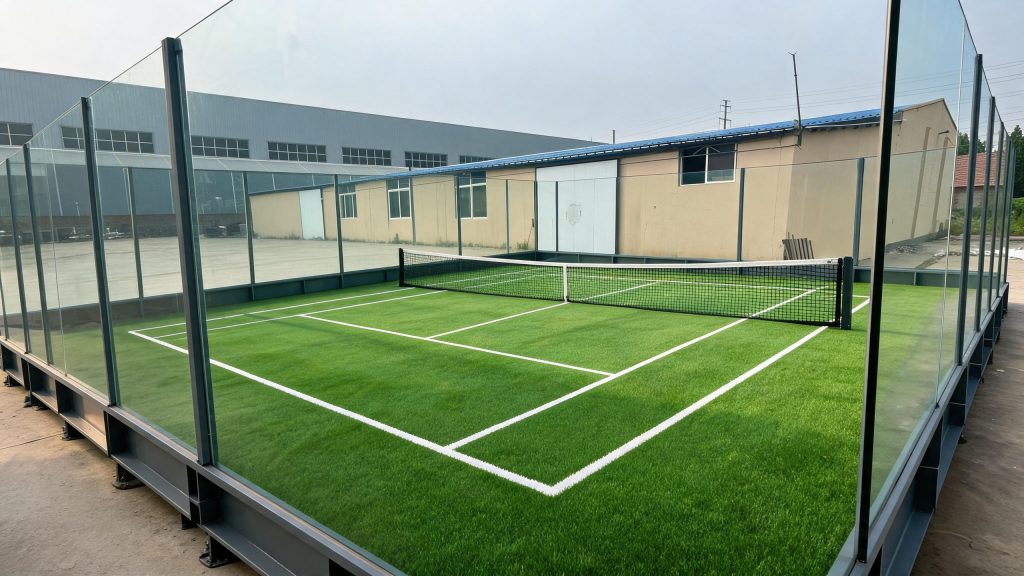
Padel and squash both happen inside four walls — that’s where the resemblance ends. Padel is a doubles-first racket sport played on a 20×10 m court with glass walls, a solid short racket, and a low-pressure felt ball. Squash is a singles game on a 9.75×6.4 m court with four solid walls, a full-length racket, and a small hard ball that you can hit against any wall. Different enough that both can thrive side by side in the same club.
If you’re a club owner deciding which court to build next — or a player wondering which sport to pick up — this comparison covers court dimensions, rules, learning curve, physical demand, cost, and return on investment.
Key Takeaways
– Court footprint: one squash court (~9.75×6.4 m + runback) fits inside the 20×10 m padel envelope with room to spare; a padel court serves four players, a squash court serves two.
– Walls: squash uses four solid walls (front wall is the main one); padel uses glass back walls and glass/mesh sides — and the ball bounces off the floor before the wall.
– Learning curve: padel is faster to enjoy (rallies in a session or two); squash demands years of technique and fitness but rewards singles athletes.
– Revenue per square meter favors padel for clubs: 4 paying players per 200 m² vs 2 per ~70 m² (fees differ by market).
– Both are growing: padel is the global growth story; squash returns as a fit-focused sport and Olympic debutant (LA 2028).
Court Size and Setup
| Factor | Padel | Squash |
|---|---|---|
| Playing area | 20 × 10 m (200 m²) | 9.75 × 6.4 m (~62 m²) |
| Freight directory | Glass back + glass/mesh sides | Four solid walls |
| Wall height | 3 m glass + 1 m mesh | Front wall 4.57 m, back 2.13 m |
| Surface | Artificial turf (typical) | Maple, concrete, or glass |
| Typical players | Doubles (4) | Singles (2), or doubles |
| Ball | Low-pressure felt | Small hard rubber |
| Racket | Solid, short (~45 cm), no strings | Strung, standard length |
The squash court is compact — that’s its superpower (two squash courts fit in roughly the same footprint as one padel court, before runback). But per square meter of playing area, padel packs four players into 200 m² vs squash’s two into ~62 m² — which is why clubs converting space usually add padel for revenue and keep squash for community and fitness. And if that space is indoors, the next decision is indoor vs outdoor — it changes cost, playability, and the roof you need.
Rules in 60 Seconds
Padel: underhand serve, below the waist, diagonal; ball must bounce on the ground before hitting the walls; walls stay live after the bounce — you can play off your own back glass, and your opponent’s shots can rebound back into play. Scoring: 15-30-40, six games to a set. Doubles-only in standard play.
Squash: serve onto the front wall above the service line; the ball can hit any wall but must land below the out-line; rallies use every wall; scoring is point-a-rally to 11 (win by 2). Singles is the classic format, doubles exists but requires a larger court.
The wall mechanics are the big difference: in squash, direct wall hits are the core of the game from the first shot. In padel, walls are only in play after the ball bounces on the ground — and the ball’s rebound off glass is gentler and more predictable than off a solid front wall.
Learning Curve: Which Is Easier?
Padel wins the ease race by a wide margin.
- Padel: underhand serve (no overhead technique), short solid racket, lower-pressure ball, and forgiving glass rebounds mean beginners sustain rallies within one to three sessions. The walls forgive mistakes — a mis-hit that hits the back glass stays in play.
- Squash: full-length racket, small hard ball, front-wall technique, and constant movement demand months of footwork and swing practice before rallies feel controlled. New players often struggle to keep the ball in play.
For social clubs, families, and new players, padel is the faster payoff. For athletes who enjoy a demanding singles sport and are willing to invest in technique, squash is deeply rewarding — and annual memberships skew toward committed players.
Physical Demand & Fun Factor
| Dimension | Padel | Squash |
|---|---|---|
| Movement | Short bursts, lateral, 4 players share court | Continuous sprinting, cuts, lunge-based |
| Intensity | Moderate-to-high, doubles pacing | Very high when played well |
| Joint impact | Low-ish (turf, smaller court) | Higher (hard stops on hard floor) |
| Fun factor | Social, rally-based, quick points | Duelling, technical, adrenaline |
| Age fit | 8–70+ | Best under ~50 at high level |
If your goal is a workout, squash singles is nearly peerless — studies clock it among the highest-calorie racket sports per hour. If your goal is time-on-court, social play, and growing a community, padel’s doubles format and faster rallies deliver more engagement per square meter.
Cost & ROI for Clubs
| Cost item | Padel court | Squash court |
|---|---|---|
| Court structure | Steel + glass + turf (premium) | Walls (plaster/glass) + floor |
| Build cost | Higher absolute (larger, more glass) | Lower absolute per court |
| Per m² cost | Lower per player served | Higher per player served |
| Typical users/court | 4 (doubles) | 2 (singles) |
| Revenue ceiling | 4 fees/90-min slot | 2 fees/45-60 min |
Padel’s per-player economics are the headline: four paying players per 90-minute slot vs two per 45–60 minutes on squash. A club converting underused indoor space into padel courts typically sees shorter payback, though squash remains a strong community anchor and fitness offering. If you’re planning the build itself, our covered court guide covers roof types, specs, and what each structure really costs.
Pricing varies wildly by market and facility type — a factory-direct quote from XTZ beats any public estimate for your site.
Which Should You Choose?
- Choose padel if you want the fastest-growing racket sport, social doubles play, quick learning, and better revenue per square meter.
- Choose squash if you love a demanding singles duel, want an affordable compact court, or already have the community and the space.
- Choose both if you run a club: padel drives growth and revenue; squash anchors fitness and long-tenured members.
Both sports are climbing — squash even returns to the Olympics in LA 2028. The smartest move is to match the court to your space, your market, and who you want playing on it.
Is padel easier than squash?
Yes, for most beginners. Padel’s underhand serve, short racket, and forgiving glass rebounds let newcomers rally within a session or two; squash’s front-wall technique and hard ball demand months of practice before rallies feel controlled.
What’s the difference between a padel court and a squash court?
Size and walls: padel plays on 20×10 m with glass back/side walls (ball bounces before the wall); squash on ~9.75×6.4 m with four solid walls (ball can hit walls directly). Padel is doubles-first; squash is typically singles.
Is squash better exercise than padel?
For pure intensity, yes — squash singles is among the highest-calorie racket sports per hour. But padel delivers more sustained, moderate-intensity play with longer rallies and less joint impact, which suits most recreational players better.
Which is more profitable for a club, padel or squash?
Padel typically wins on revenue per square meter: four paying players per 90-minute slot on 200 m² vs two per 45–60 minutes on ~62 m². Squash remains a strong community and fitness anchor, but padel drives growth.
Can you convert a squash court to padel?
Rarely directly — a squash court is far smaller than 20×10 m with solid walls that can’t host padel’s glass-and-turf build. Clubs usually repurpose the space (multiple squash courts + hall) for a padel build, not the court itself. — Author: XTZ Padel Team — Meta Title: Padel vs Squash: Courts, Rules & Which to Play Meta Description: Padel vs squash compared: court size, walls, rules, learning curve, physical demand, and club ROI — plus how to choose the right court. Primary Keyword: padel vs squash Secondary Keywords: padel vs squash court size, padel or squash which is easier, squash vs padel for fitness, padel court vs squash court URL Slug: /archives/263 Word Count: 1,320 —