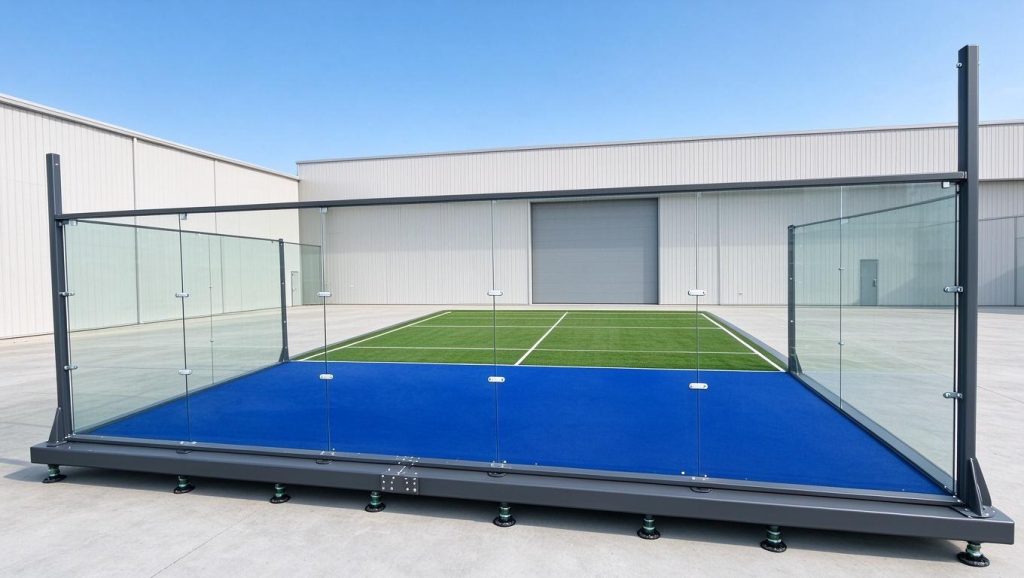
A padel court is a commercial asset that works 10-14 hours a day — and like any asset, it depreciates fast if you ignore it and lasts a decade-plus if you don’t. The good news: padel court maintenance is simple, cheap, and mostly about interfaces — the turf seams, the glass fixings, the net tension, the drains — not the materials themselves.
This guide is the maintenance manual every court owner should have: a quarterly routine, an annual checklist, the cost reality, and how to spot problems before they become replacement bills.
Key Takeaways
– 15 minutes per court, four times a year separates a court that lasts 12 years from one that fails at 5. Maintenance is cheap; replacement is not.
– Four interfaces to inspect every quarter: glass fixings (torque), gaskets, turf seams/infill, and net tension.
– Turf needs sand top-ups every 1-2 years and annual brushing/cleaning; infill loss is the #1 silent killer of bounce quality.
– Glass almost never fails from play — it fails from installation stress and edge damage. Check fixings and gaskets, protect edges.
– Budget roughly $300-800/court/year for consumables and cleaning; most court components have 8-15 year lifespans with this care.
The Quarterly Routine (15 Minutes Per Court)
Set a calendar reminder every 3 months and walk each court with this checklist:
Glass & structure
- Check fixing bolt torque (vibration loosens bolts; loose fixings let panels rattle and stress the edges).
- Inspect gaskets for compression, cracking, or UV degradation (glass must never touch metal directly).
- Walk the perimeter; look for new edge chips or impact marks on panels.
- Check frame coatings for rust spots (touch up immediately outdoors).
Turf
- Check seams for lifting, gaps, or exposed backing.
- Look for infill loss in high-traffic zones (service boxes, center line).
- Remove debris (leaves, dust) that packs the fibers.
Net & posts
- Check net tension and center-strap height (0.88 m at center).
- Check post anchoring and the net cable for fraying.
Drains & perimeter
- Clear drains and perimeter channels (blocked drainage = standing water = turf damage and slippery courts).
Fifteen minutes per court, four times a year. That’s the whole routine.
The Annual Checklist
Once a year (or pre-season):
- Deep turf service: professional brushing (de-compact the fibers), deep clean, and infill top-up to spec weight (12-18 kg/m²).
- Full torque audit: re-torque all glass fixings with a calibrated wrench to spec.
- Gasket replacement in UV-exposed zones if cracked (EPDM/neoprene; cheap vs panel replacement).
- Structural inspection: check steel for coating wear, welds for hairline cracks, roof/covered structures for drainage and corrosion (see covered court guide).
- Lighting service: clean LED lenses, check optics alignment, confirm lux levels (see padel court lighting).
- Netting/mesh check on side walls (mesh tears let balls out and players down).
- Documentation: log everything — a maintenance log is your warranty evidence and your resale value.
Cost Reality: Maintenance vs Replacement
| Item | Maintenance cost | Replacement cost |
|---|---|---|
| Turf sand top-up (1-2 yr) | $100-300 | — |
| Annual deep turf service | $200-500/court | — |
| Gaskets (occasional) | $50-200 | — |
| Glass panel replacement | — | $300-600/panel (rare if maintained) |
| Turf replacement (8-12 yr) | — | 10-15% of court budget |
| Frame repaint (10+ yr) | — | 5-8% of court budget |
The pattern: maintenance line items are tiny; the replacement bills they prevent are large. A court that skips quarterly checks will face a glass panel failure (installation stress or edge damage that a check would have caught) or a turf that bounces dead two years early.
The Two Failure Modes to Actually Worry About
1. Glass failure from fixings, not play. Roughly 90% of padel glass breakages trace to installation stress — over-tightened bolts, missing gaskets, misaligned frames (our padel court glass guide covers the full breakdown). A quarterly torque-and-gasket check is your cheapest insurance policy.
2. Infill migration and turf compaction. Every game pushes sand out of the high-traffic zones toward the walls. Over time the center plays faster, the edges play dead, and bounce consistency dies. The fix is routine: brushing and sand top-up. Courts that skip it play like a different sport after 3 years.
Extending Lifespan: The Professional’s Secrets
- Use a maintenance log (date, work, who did it) — it’s warranty leverage and makes resale easy.
- Match maintenance to climate: coastal salt air corrodes steel faster (touch up coatings annually); hot climates degrade UV more (use UV-stable materials, shade where possible).
- Don’t let members “fix” courts: torque specs matter — a member tightening a loose glass fixing can over-torque and crack the panel. Train staff or hire a pro.
- Indoor vs outdoor: indoor courts still need the quarterly routine; outdoor adds UV and drainage to the watch-list.
How often should I maintain a padel court?
A light inspection every 3 months (glass fixings, gaskets, turf seams, infill, net tension, drains) plus an annual deep service (brushing, deep clean, infill top-up, full torque audit, lighting clean).
How much does padel court maintenance cost?
Budget roughly $300-800 per court per year for consumables, cleaning, and minor repairs — a tiny fraction of a court’s value. The cost of not maintaining is glass panels, premature turf replacement, and lost bookings.
How long does a padel court last?
8-12+ years for turf, 10-15 years for glass and structure with proper maintenance. Glass panels can last decades if fixings and gaskets are checked; turf life depends on infill care and UV exposure.
How do I clean padel court turf?
Annual professional brushing plus periodic light brushing to lift fibers, remove debris, and de-compact infill. For spills, use turf-safe detergent and rinse — avoid pressure washing on high settings that strip infill.
Do indoor padel courts need maintenance?
Yes — the same quarterly routine applies (torque, gaskets, seams, net). Indoor courts avoid UV and drainage stress, which extends turf and coating life, but lighting and ventilation need their own checks.
Conclusion: 15 Minutes, Four Times a Year
Padel court maintenance isn’t a project — it’s a rhythm. Fifteen minutes per court per quarter, an annual deep service, and a maintenance log. That rhythm is what turns a 5-year court into a 12-year court, protects your glass, your turf, and your bookings, and keeps every bounce playable for the members who pay for it.
How much of that workload you inherit is decided at purchase: the padel court surface and turf guide compares turf types, base preparation and lifespan.
When you spec your next court — or service your current one — ask for the maintenance plan as part of the purchase. Talk to the XTZ Padel team and we’ll walk you through the spec sheet and the service routine that keeps it playing like day one.