

Key Takeaways
– The XTZ classic padel court is built in a fixed sequence: confirmed drawings, steel fabrication, surface treatment, module assembly, quality checks and container packing.
– Pre-fit modules and labeled packing keep on-site assembly to a few days for a local crew.
– Classic courts are framed structures designed for commercial venues — high player throughput and low maintenance.
Buyers usually see a padel court as a finished product on a venue floor. Today we walk through how the XTZ classic padel court — our framed configuration for commercial venues — actually travels from a confirmed drawing to a sealed container.
Step 1: Drawings frozen, materials staged
Production starts only when technical drawings are confirmed and frozen on both sides. The court’s footprint, post layout, glass arrangement and turf color are locked into the production sheet. From that moment, any change is a formal revision — which is exactly why we push to settle open questions before an order enters the queue, not during it.
Step 2: Steel fabrication and surface treatment
The load-bearing structure is fabricated from steel sections: posts, beams and the framing that carries the glass panels and turf. After welding, the structure receives its anti-corrosion surface treatment — the step that decides how a court behaves after years of rain, humidity and pressure washing. Our courts are manufactured in Hengshui, Hebei, a region with a mature steel-processing supply chain.
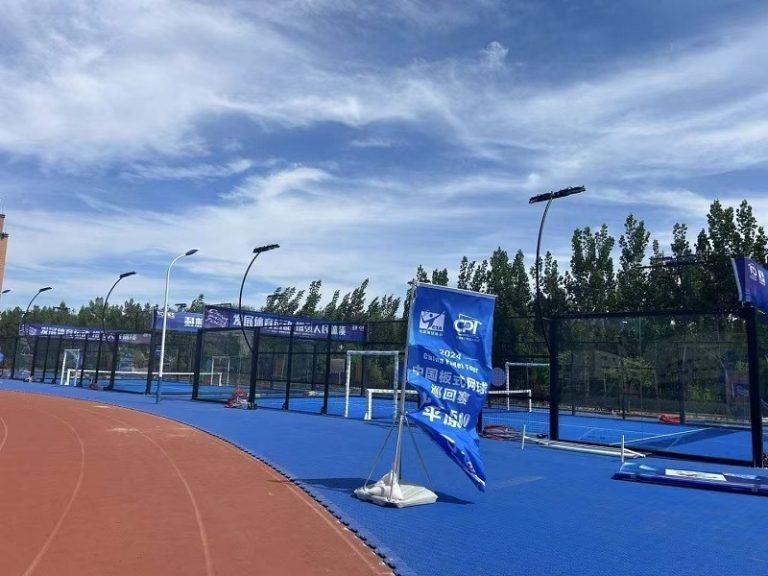
Step 3: Module assembly and quality checks
Frames are assembled into transport-sized modules at the workshop, not improvised on site. Glass positions, mesh panels and post bases are pre-fitted so the installation crew reassembles rather than fabricates. Each module passes a fit-up check before packing — the point where misalignment is cheapest to fix.
Step 4: Packing and dispatch
Modules, glass, turf, net posts and fixings are packed and labeled by court, with assembly documentation included. A full court set travels in standard containers, which keeps freight predictable and lets a venue receive two or more courts in one delivery.
Why the classic layout suits commercial venues
The framed classic structure is the workhorse of high-throughput clubs: it is the configuration most of our commercial venue clients start with, and it pairs a familiar playing experience with a robust, low-maintenance enclosure. For venues weighing options, our guide on choosing the right padel court compares configurations by venue type.
Want this configuration quoted for your venue? Send your site dimensions through the request a quote page and our team will confirm drawings, delivery dates and freight in one reply.
Written by the XTZ Padel Team — a padel court manufacturer and supplier serving clubs, contractors and distributors worldwide.
 English
 Spanish